|
Radio
Boulevard Collins Radio Company 51J Series of Receivers - Part 2 70E-15 "M" PTO vs "CR" PTO,
End-Point Errors, Repairing the 70E-15 "M" PTO
Back to Part 1
On to Part 3
On to Part 4 by: Henry Rogers WA7YBS |
|
|
PART 2 |
|
51J Series - Oddities No receiver is perfect and the 51J Series receivers do have a few "oddities" that can cause user frustration during set-up and operation. The sloping top on all 51J receivers almost necessitates using some type of cabinet if you like to utilize the area on top of the receiver for various accessories. The Oldham coupler can cause some minor backlash issues in the tuning. The five "oddities" that cause the most problems are covered below. The PTO end-point error is probably the most serious issue but, luckily, it almost always only affects the early R-388 and possibly the 51J-3. The PTO serial number identification involves the R-388, 51J-3 and the 51J-4. I might have gone "over-board" on detailed information on the 70E-15 PTOs but I really think the common belief that ALL 70E-15 PTOs can't be calibrated without some modification needs to be corrected. Only the 70E-15 PTO used in early R-388 receivers and possibly 51J-3 receivers might require the "Orr fix." The later version of the 70E-15, introduced with the 51J-4 in 1955, can be easily calibrated without modifications. Lots of photos and info. Other minor oddities are the Break-in function which is a headache but only affects the R-388, 51J-3 and 51J-4. The BFO "inversion" will complicate selecting the proper upper or lower sideband and is a function of the front-end design so it affects all versions of the 51J receivers. The audio issues are integral to the 51J design and affect all versions on the 51J Series. The R-388, 51J-3 and J-4 might cross-modulate in the presence of a strong RF field when used with a large, non-resonant antenna. |
|
The 70E-15
PTO
The "M" version versus the "CR" version - Nowadays, an "as found" 70E-15 "M" version,...that is,...the type only found in the early R-388 receivers (those built from 1950 up to about 1955,) will never meet its accuracy specification due to excessive end-point error that usually can't be corrected with the L002 trimmer adjustment provided. It was thought that the type or mix of ferrite used for the PTO core had aging problems that didn't show up immediately. However, the L002 L-trimmer was provided to compensate for "aging" changes that happened to all of the Collins PTOs. But, for some reason, it seemed that the 70E-15"M" PTO changed more than was expected. Just how long did it take for the calibration end-point errors to develop? It's very likely that the 70E-15 "M" EPE problems really developed into serious problems around the mid-1950s. Collins improved the 70E-15 PTO around the time that the 51J-4 was introduced. ALL 51J-4 receivers were equipped with a 70E-15C.R. PTO. These "C.R." versions seldom have an uncorrectable EPE and usually can easily be calibrated just using the L002 L-trimmer provided. Although the schematic never changed for the 70E-15 PTO, obviously something inside was changed to make the "C.R." versions maintain their calibration and their ability to be calibrated much longer. A visual examination of the "M" versus the "CR" interior construction will reveal no visible significant changes. A few minor differences are apparent when examining the PTO interiors "side-by-side." I've photographed the interiors of the "M" and the "CR" PTOs and the comparison photos are further down in this section. The last contract for R-388 receivers was a small one in 1962 but the majority of R-388 receivers, those built from 1951 up to about 1955, are considered the "early" R-388 receivers and those receivers exclusively used the "M" version PTO. Why "M" versions develop uncorrectable EPE - As it became apparent that something about the 70E-15 "M" was causing an ever-increasing number of PTOs to fairly rapidly develop "uncorrectable" end-point errors, meaning that the normal L-trimmer adjustment had insufficient range to bring the PTO back into specification, the first thought (by users and owners) was that the aging of an unstable mix used in the ferrite core was causing the problem. It should be pointed out that all types of Collins PTOs will change calibration over time and it was an expected aging factor. That's why the L-trimmer was provided. It's probably also why the 70E-15 PTO's internal components were "sealed in a vacuum" and why Collins insisted that PTOs that had been field calibrated must be returned to Collins for recalibration where the vacuum seal was the last step in the process before the corrected PTO was returned. However, the PTOs weren't returned to Collins very often and therefore most PTOs had their vacuum seal lost with the first adjustment for calibrating the PTO and thereafter the components inside, including the ferrite, were exposed to the air and moisture which could then cause "rapid deterioration" the PTO components inside (the quote "rapid deterioration" is directly from the Collins R-388 manual.) Could the uncorrectable EPE have been caused by the end user? - There weren't any documented internal changes made to the 70E-15 PTO. The schematics shown in 51J-3, R-388 and 51J-4 manuals are all identical. The only obvious external difference is that the 51J-4 regulated +150vdc was provided with better filtering with an added electrolytic capacitor and a "T" filter on the 0A2 regulator tube. This filtering change also shows up in the later R-388 receivers (1957 contracts.) Also, these later R-388 receivers have PTOs that show both the "M" prefix and the "CR" suffix on the same serial number, e.g., M11254C.R. or M10816C.R. Since there aren't any differences in the 70E-15 PTOs that can be shown on schematics, the difference must be something not visible, such as the type or mix of ferrite used in the cores of "CR" PTOs. But, for the "M" PTOs, it could also be that the differences were in how the receivers were used in the field. Collins believed that the problem wasn't something that happened to every 70E-15. It took a specific set of circumstances in the field and then a few years for the uncorrectable EPE errors to develop. While the ferrite core might develop a correctable EPE just by aging, the excessive EPE problem probably started the first time that the PTO was calibrated in the field with the removal of the L002 L-trimmer access hex-plug that then allowed air and moisture to enter the PTO. In their manuals, Collins even mentions the possible contamination that could happen with a field calibration "breaking the vacuum seal" and air-moisture ingression causing "rapid deterioration" of the PTO's internal components. In anticipation of possible vacuum-loss problems and knowing that most customers were not going to return their PTO to Collins for recalibration and resealing, starting with the "CR" PTOs, Collins included two desiccant packets inside each 70E-15 "CR" Since the problem was almost always with the "M" PTO in R-388 receivers, it seems that the operational environment, where the R-388 receivers were often turned on 24/7, could also have been a factor, perhaps accelerating the deterioration of PTO components after the vacuum loss. Collins certainly wouldn't have put too much time into analyzing a problem that they essentially corrected with the "CR" version of the PTO in 1955. In fact, after 1954 and up to 1962, a total of only about 1000 R-388 receivers were built on just a few military contracts in those eight years. And, the 1957 and later R-388 receivers have more 51J-4 characteristics (including the "CR" added to the serial number of these later PTOs) making these late-R-388s significantly different than the early-fifties R-388s. Collins did produce a write-up specifically on the 70E-15 PTO around 1959 but exactly what is covered in that document is currently unknown (I can't find it on the Internet or from the CCA. It's mentioned in a Hollow State Newsletter but apparently Dallas Lankford couldn't find a copy of it either.) More Experimenting and Speculation - About the only research on the 70E-15 "M" problem has been by collectors, starting with Bill Orr back in December 1969 with Orr's write-up in 73 magazine. Orr's solution of removing one turn on the L002 L-trimmer has been the commonly used "fix" necessary to return the 70E-15 "M" to a somewhat useable accuracy. What I've noticed, although my examples are certainly limited, is that nearly all R-388 receivers (14 receivers examined) had excessive EPE. Interestingly, out of five 51J-4 receivers examined, three of which I had calibrated their PTOs, none had uncorrectable EPE (the three PTOs were "C.R." versions of the 70E-15 and were cal'd to <1kc EPE using just L002.) Besides the "CR" PTO correction, perhaps other factors might be considered, e.g., the 51J-4 being a civilian receiver was much less likely to be operated 24/7 and therefore the heat-build up never happened. Also, a 51J-4 being civilian or commercial, probably never went through a scheduled maintenance program that routinely calibrated the PTO. One very important observation is the formidable disassembly required for PTO calibration certainly resulted in many 51J-4 receivers never having their PTOs calibrated which may have preserved their vacuum environment much longer than the typical R-388 "M" PTO. The result being that the 70E-15 C.R. PTOs in 51J-4s are seldom found with excessive EPE that can't be corrected with just a standard adjustment of the L-trimmer (I've corrected several 51J-4 CR PTO's EPE just using L002. Also, one 1957 R-388 PTO that had both "M" and "CR" in the serial number.) This means that nearly ALL early R-388 receivers will have a 70E-15 "M" PTO with excessive EPE and that could be due to an early vacuum loss followed by moisture ingression and the deterioration accelerated by 24/7 operation of the receiver. On the heat factor, a point could be made that the R-390 and R-390A PTOs, the 70H-12, were designed to operate inside an oven and these PTOs are never found (okay,...very rarely found) with excessive EPE that can't be adjusted out. Collins could and did produce the 70H-12 for a heated environment so why would the 70E-15 be adversely affected by 24/7 heat build-up? The 70H-12 was "pressurized" with nitrogen, an almost inert gas, which might have had something to do with the longevity of the PTO calibration but, like the 70E-15, the first EPE adjustment releases the N2 pressure and air enters the PTO (I've only found one 70H-12 that still had N2 pressure when I removed the plug to adjust the EPE - an excellent seal that lasted for decades - but still, the EPE needed a slight "touch-up" after those decades.) For the 70E-15, this again points to the combination of the ferrite core contamination due to the loss of vacuum allowing air-moisture ingression and 24/7 operation accelerating the aging and, even then, a problem that really didn't develop for several years and only affected R-388 receivers built from late-1950 up to 1954. The upshot is that ANY 70E-15 PTO might be found with excessive EPE problems but almost all of the "serious uncorrectable EPE problem" PTOs will be 70E-15 "M" versions found in 1950 to 1954 (early) R-388 receivers. Sometimes a 51J-4 receiver equipped with the 70E-15 "C.R." version PTO will be found with a high EPE but always the EPE can be corrected by calibrating the PTO just using the L002 trimmer provided. This uncorrectable EPE PTO problem could also affect 51J-3 receivers but there aren't enough examples of "no prefix/suffix" 70E-15 PTOs that have been recalibrated recently to have sufficient information on that point. The good news is Bill Orr's solution is a relatively easy "fix" for the uncorrectable EPE problem found in "M" PTOs in R-388 receivers. But, be aware that it's not a perfect fix with the linearity and the adjustment range becoming compromised in the attempt for a better EPE. The good news is that ALL 51J-4 receivers have their 70E-15 PTO identified with a "CR" or "C.R." suffix added to the serial number. ALL early R-388 receivers have their 70E-15 PTOs identified with a "M" prefix to the serial number. There are 70E-15 PTOs that don't have a prefix or a suffix on the serial number. These PTOs are found in 51J-3 receivers and also much later as replacement spares. So, even if the PTO has been removed from a receiver, it's still possible to tell in which receiver the PTO was used. The letter suffixes and prefixes were only an identification that showed in which receiver that particular 70E-15 was installed. |
|
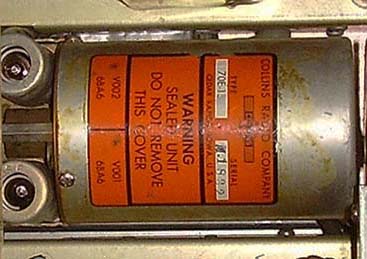
Identifying R-388 "M" PTOs |
|
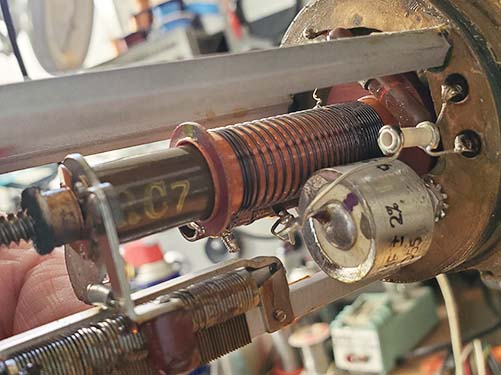
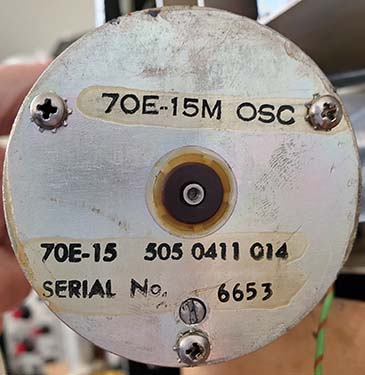
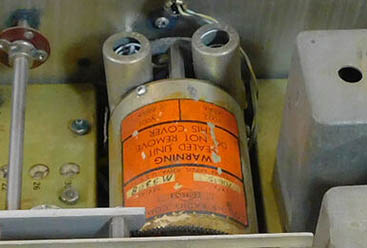
1951 R-388 PTO with "M" prefix serial number |
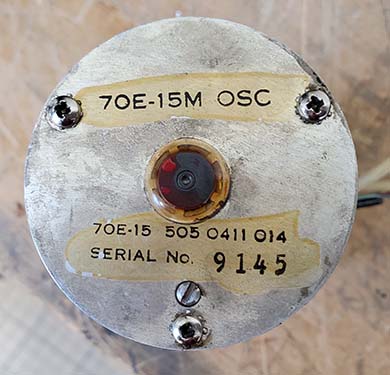
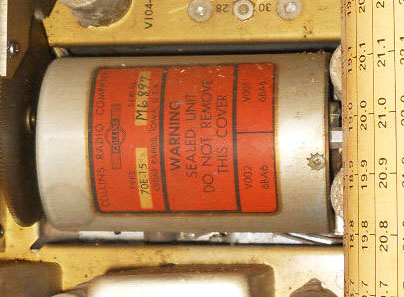
1953 R-388 SN:4991 PTO with "M" prefix SN |
|
|
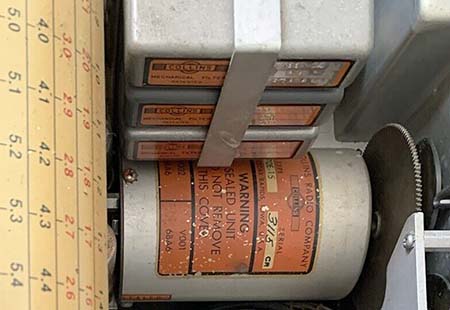
Identifying 51J-4 "CR" PTOs |
|
|
|
|
| "M" and "C.R."
End-Point Error Comparisons
- Now, I've found R-388 receivers with the "M" PTO that
haven't been worked on and didn't have an EPE that couldn't be adjusted to <1kc, but it's very rare
(2 out of 14 receivers examined.) Nearly all R-388 receivers
(that haven't had the PTO worked on) will have an end-point
error much greater than 10kc which for a "M" PTO might be beyond the
compensation adjustment. Nearly all "M" PTOs that I've tested have been
in the 8kc to 12kc area of EPE. The worst one I've ever tested was barely working and had an EPE
of 30kc! The best 70E-15 I ever tested was a NOS spare that was
found
still in the original box. This PTO was still in calibration and had no EPE! The best
"in the receiver" 70E-15 "M" had an EPE of only 3.5kc (R-388
Collins Mfg SN 9108.) The NOS
PTO does
seem to indicate that vacuum loss due to removal of the hex plug
for calibration and the resulting air-moisture ingression could
be responsible for EPE problems since this NOS PTO had never
been calibrated and apparently still didn't require it. Possibly long-term heat from 24/7 operation
could accelerate the deterioration and be partially responsible for the
change in the ferrite core that causes the "M" PTO EPE
problems.
Good News on "C.R." PTOs - I just recently (Dec-2025) calibrated four 70E-15 "C.R." PTOs that had EPEs of 15kc, 11.5kc, 8.5kc and 4.5kc. All four of these "C.R." PTOs were calibrated to <1kc EPE and about 1kc of linearity deviation just using L002. An interesting observation was on all but one of these PTOs, the hex plug still had "unbroken" green Loctite seal indicating these three PTOs had NEVER been tampered with and the shield-cover seal was still present although slightly cracked which is normal for these fragile decal-type seals. However, the PTO that didn't have the green Loctite seal on the hex-plug actually had the lowest EPE and indications were the last calibration was in 1971 at Collins. That implies that after 54 years, the EPE had only increased to 4.5kc. However, since this particular PTO is in a Collins Laboratory 51J-4, it might have been possible that the 1971 Collins calibration also resealed the vacuum environment in that PTO and that's why it didn't change much in 54 years (again, just more speculation.) Although an EPE test will show the current condition of any PTO, actually trying to calibrate the PTO will reveal how well preserved the internal parts are and, with some adjustments of L002, it won't take too long to find out IF the PTO can be calibrated. So far, I'm having good luck just calibrating the "C.R." versions. Photographic Comparison Inside the 70E-15"M" and the 70E-15 "C.R." - Nowadays, in 2025, with nearly 70 years of aging, even 51J-4 "CR" PTOs are commonly found with a fairly high EPE which seems to indicate that after decades of existence, the PTO seals have broken down and allowed a slow ingression of air-moisture into the PTO body (the desiccant packs have certainly "turned pink.") It's rare to find a "CR" PTO that has had its hex-plug removed, so the failure of the vacuum seals seems to be a logical assumption to add to the list of other "factors" for the PTO EPE issues. It's not unusual for R-388 "M" PTOs to be found with >12kc of EPE today and 51J-4 "C.R." PTOs generally are found with 4kc to 8kc of EPE. However, if air contamination (loss of vacuum) is the root cause, then Collins was correct in their statement that accessing L002 to calibrate the PTO was only a temporary field fix and the PTO needed to be sent back to Collins as soon as possible for proper calibration and sealing (restoring the vacuum.) >>> |
|
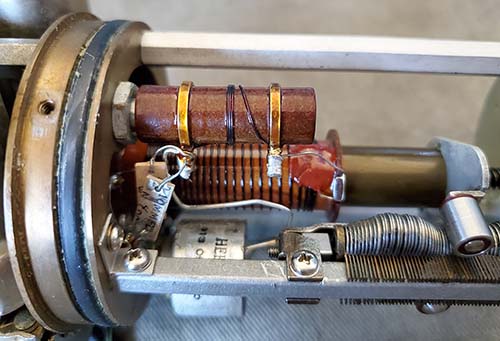
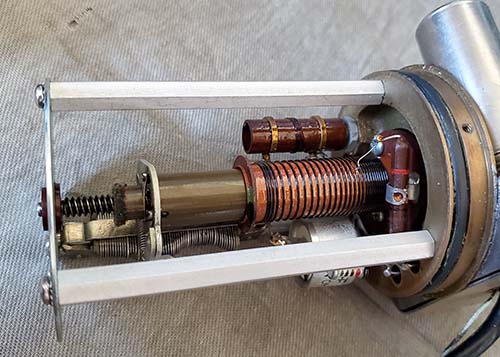
70E-15
"M" SN: M 2744 from ca: 1951 R-388
|
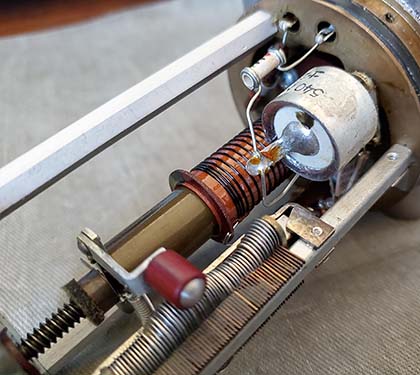
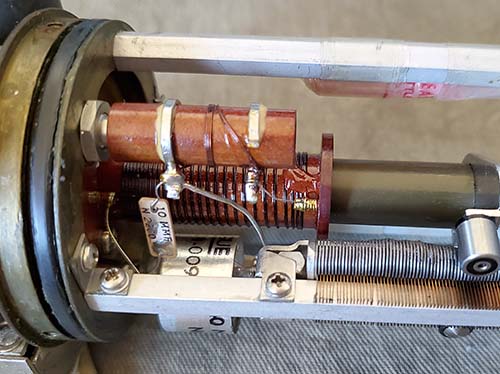
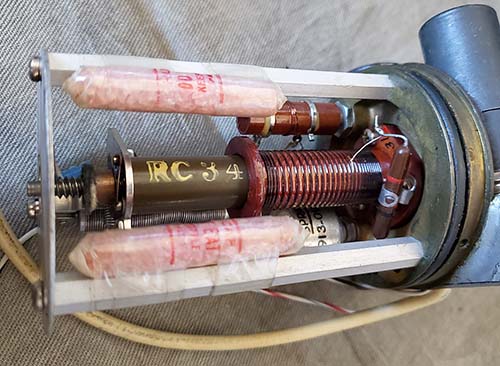
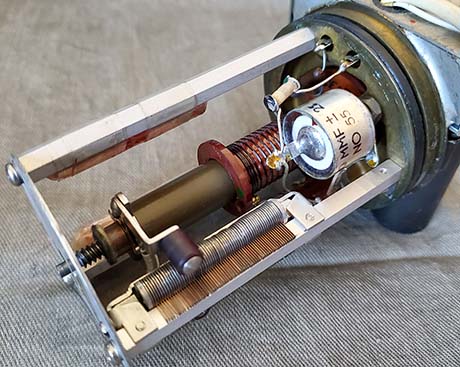
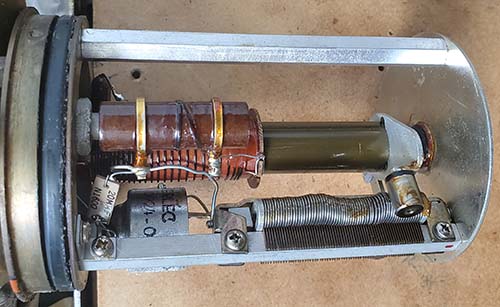
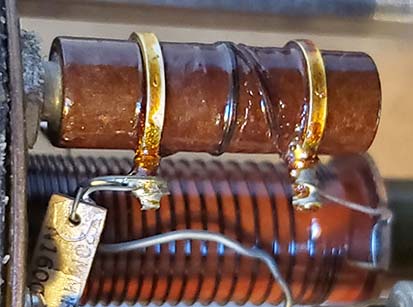
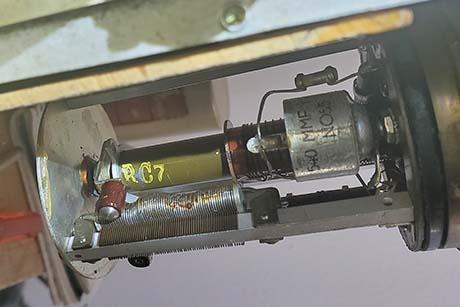
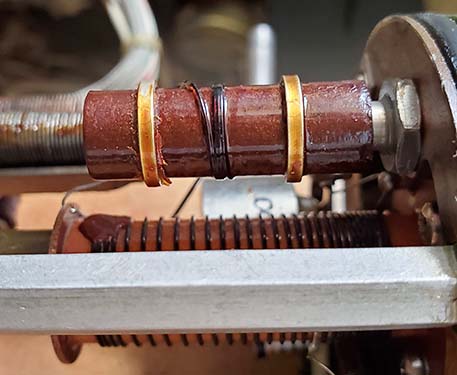
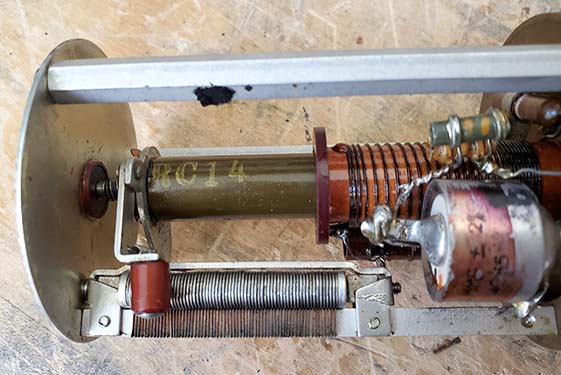
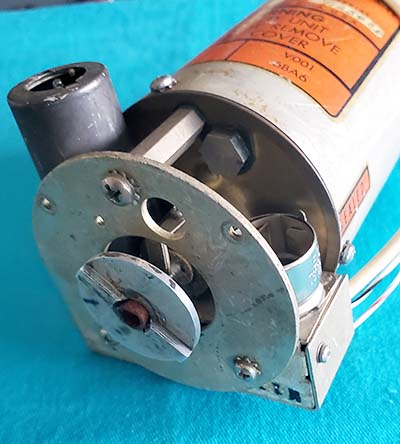
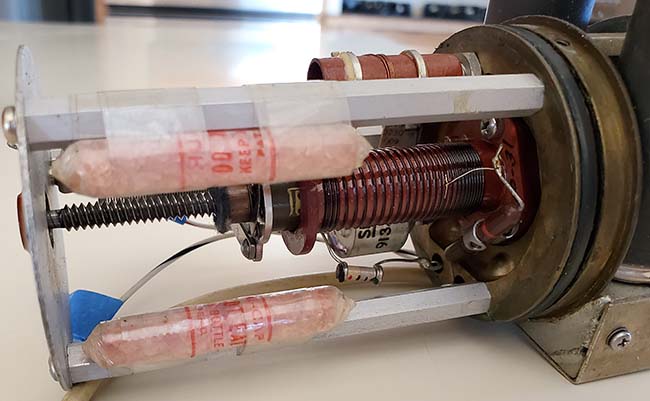
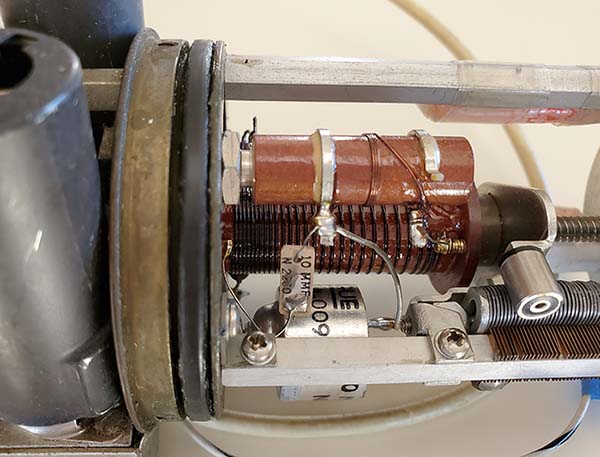
>>> Expecting any negative-pressure seal to last 70 years and maintain a vacuum is probably wishful-thinking. However, I've found several "C.R." PTOs that still have the hex plug sealed with green Loctite indicating that L002 was never accessed and the vacuum may have been preserved much longer than the typical "M" PTO. ALL of these CR-type of 70E-15 PTOs were easily adjusted for <1kc EPE just using L002. Evidence seems to indicate that field calibrations of the PTO followed by not returning the PTO to Collins for reworking is the primary cause for excessive EPE. That could happen to a 51J-4,...but not very often. Another scenario is that perhaps slight differences in construction and components between the "M" PTO and the "CR" PTO actually prevents the "CR" PTO EPE from ever increasing to the point where it can't be recalibrated just using L002. Photographic Evidence - A side-by-side comparison of the internal structure of a "M" and "CR" version provides some interesting speculation since there are virtually no differences that visually stand out. Here are some things noticed: 1. Ferrite core in the "C.R." PTO is identified as "RC 3 4" while the ferrite core in the "M" PTO has no identification. Both cores are dark olive green but this is usually just a coating of paint that protects the ferrite and prevents contact with the actual ferrite material (since it's conductive.) 2. Desiccant packs are installed in the "C.R." PTO but not in the "M" PTO. 3. Note the wide variability of the washer stack in the "M" PTO versus the almost flat washer stack in the "CR" PTO indicating that the "CR" ferrite material versus its position within the inductance is much more linear and perhaps a different permeability or mix of ferrite material. Conclusions - The most significant visual differences would be the desiccant packs in the "C.R." PTO and the fact that the ferrite core is identified in the "C.R" PTO. If the ferrite core is different in the "C.R" PTO (requiring identification) that would be a significant change that certainly could be the reason that the "C.R." can be easily calibrated just using L002. The ferrite material might also be responsible for the almost flat washer stack linearity adjustment. The lack of desiccant packs in the "M" PTO is a surprise since the earlier 70E-7A used in the 51J-1 and 51J-2 had a desiccant holder on top of the PTO. The difference was that the 70E-7A wasn't sealed where the 70E-15 was a sealed-vacuum environment. Speculation - The conclusion is that loss of vacuum due to field calibrations removing the hex-plug to access L002 resulted in air-moisture ingression. This was then followed by not returning the PTO to Collins for proper recalibration and sealing. The air-moisture contamination may have affected the ferrite causing it to change permeability to the point where L002 didn't have the range of adjustment necessary for calibration. These actions were probably responsible for the "M" PTO problems. The "C.R." PTOs found in 51J-4 receivers were not even calibrated very often and therefore the vacuum seal lasted much longer. Additionally, desiccant packs absorbed moisture ingression as the PTO seals aged. Perhaps a different type of ferrite, RC34, was less affected by the loss of vacuum and air-moisture ingression. The upshot is, expect early 70E-15"M" PTOs to be difficult to calibrate while the 70E-15"CR" usually calibrates easily just using L002. |
|
|
Identifying the Various Types of 70E-15 PTOs from their Serial Numbers 70E-15 "M" and "C.R." and "no prefix/suffix" Serial Numbers - More Info and Production Discrepancies |
|
70E-15 PTO Serial Numbers in General -
Evidence indicates that all of the 70E-15 "M" PTOs were
serialized from the same roster. It also appears that
the later 70E-15"CR" PTOs were serialized from
their particular roster. There were also the 51J-3
receiver's PTO that used serial numbers
that didn't have either a prefix or suffix and just had
numbers. Although there aren't too many examples of the "no
prefix/suffix" PTOs, it appears that these "no
prefix/suffix" PTOs were serialized from their own
roster. Examples of the "no prefix/suffix" PTOs are found in 51J-3 receivers with PTO serial
numbers of 753, 945 and 5991 as a few of the examples seen. Exactly when the use of the "CR" started
to be added to non-military PTOs
isn't known at this time but it was probably near or at the
end of 51J-3 production since all 51J-4 PTOs use
the "C.R." suffix.
The 70E-15 PTO serial numbers appear to be a sequential block of numbers within the "M" prefix and another sequential block of numbers within the "C.R." suffix units. All 70E-15 PTO serial numbers examined, so far, seem to show an ever-increasing progression of the associated block numbers assigned as the receivers they are found in are obviously of later and later manufacture. The highest 70E-15 PTO serial number I've seen so far has been 11802 and it belonged to a NOS/NIB spare PTO. It's usually estimated that about 12,000 R-388 receivers were built and the quantity of "M" PTO serial numbers seem to agree with that estimate. The 70E-15 PTO "M-11254-C.R." is the highest serial number actually marked with a "M" prefix, seen so far (even though the "M" looks like an after-thought) and, although found as "just the PTO," it appears to have been pulled from a 1957 contract R-388 receiver. The 51J-3 used the 70E-15 with "no prefix/suffix" serial numbers, the 51J-4 always used the "C.R." PTO and all early (1950 to 1955) R-388 receivers have "M" PTOs installed. The 51J-4 PTO serial numbers start at around 1500 but that could just be when Collins started putting "C.R." on the "no prefix/suffix" PTOs. However, there is a 51J-3 PTO with a SN of 5991 with no prefix or suffix that conflicts with the supposed roster and implies the PTO might be a "M" roster SN, without the "M". But, the 1959 51J-4 SN: 3805 has a PTO with the SN of 5572CR. All of these chronological conflicts imply that the PTO serial numbering system wasn't consistent and probably changed often. Most often it appears that "M" PTOs had their roster, "CR" PTOs had their roster and "no prefix/suffix" had their roster. As always,...there will be exceptions and apparent conflicts due to the persistent variations found in production manufacturing. PTOs that were serialized from the "M" roster would be part of the 11,000+ PTOs used in R-388. The "C.R." PTOs should account for about 7500 PTOs installed in the 51J-4 production (with PTO SNs ranging from 1500C.R. to 9000C.R.) Then there are the no prefix/suffix that probably account for about 1500 early 70E-15 PTOs installed in 51J-3 receivers. This amount of PTOs is approximately equal to the estimated R-388/51J-3 and 51J-4 production total, or about 20,000 receivers. |
|
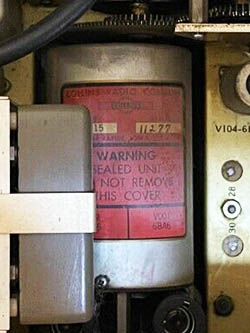
| Very Late 70E-15 PTO with SN: 11277 - Sometime after the R-388 contracts ended and the last 51J-4 receiver was built, the "C.R." suffix and the "M" prefix were dropped entirely because any 70E-15 PTOs required or sold would be considered "spares," that is, a replacement 70E-15 PTO. One example of the "spares" 70E-15 PTO was found in a "51J-3 to 51J-4" conversion (installation of the 354A-1 Mechanical Filter Kit.) The serial number on this PTO is 11277. It's possible that the mechanical filter kit and the PTO were both purchased from Collins specifically for this conversion that probably was performed after the 51J-3 became an affordable receiver (mid-1960s.) Since the last R-388 contract was in 1962 and the last 51J-4 was around 1964, a good guess for this PTO would probably be about 1965. Since this PTO was a replacement and was "new" in 1965, it's interesting that this later 70E-15 PTO has a tested EPE of 8.5kc! This was totally unexpected! However, this PTO was easily calibrated to <1kc EPE and <1kc linearity deviation just using the L002 L-trimmer. But it does seem to confirm that some change was made to the "CR" PTO and to the later spare PTOs. Perhaps the type of ferrite core was changed for the "CR" PTOs. Also, desiccant packets were added to the "CR" PTO. |
| Three
70E-15 "M"
prefix
PTOs with a "C.R." suffix (photos below) - These PTOs have serial
numbers with the "M" prefix indicating it was installed in
a R-388 and there's also a suffix of "C.R." that
usually indicates
it was for a civilian 51J-4.
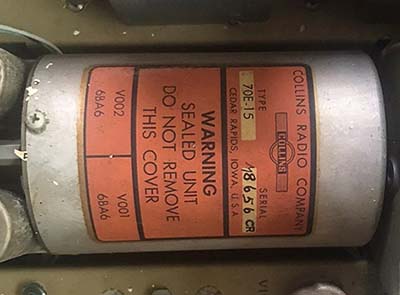
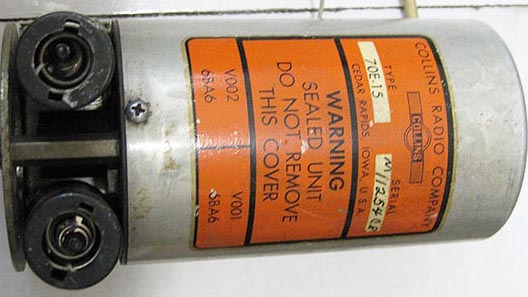
SN: M8656CR is the earliest PTO I've seen with both the "M" prefix and the "CR" suffix. It was found in a 1953 contract R-388 with a SN: of 1713. The "M" certainly looks like it was added after the numerals (ink doesn't match.) The "CR" is stamped which is also odd. The PTO SN of M8656 seems plausible for a 1953 contract R-388 but since this receiver wasn't inspected "in person" it's impossible to tell if this PTO is original to the receiver. The next PTO is SN: M-10816 C.R. and this PTO was found in a 1957 contract R-388. Notice that the chassis doesn't have the Iridite and MFP coating and is like the 51J-4 chassis. The PTO SN: M11254C.R. is the highest "M" serial number I've seen that has the "M" prefix and the "C.R." suffix, so far. Unfortunately, only the PTO exists so the specific receiver it was removed from is unknown (although it's certainly from a 1957 or later contract R-388.) As to why it has both the "M" prefix AND the "C.R." suffix are on these PTOs? Unknown at this time. One could speculate that the "CR" indicated that the newer RC34 ferrite core was installed. NOTE: PTO SN: M11254C.R. was tested and found to have an EPE of 15kc! Nowadays, predicting which particular type of 70E-15 PTO will exhibit excessive EPE is probably impossible. Interestingly, I was able to recalibrate this PTO to have an EPE of <1kc and with a linearity deviation of about 1kc. This was accomplished only using the L002 trimmer adjustment. Totally unexpected but a nice surprise. A possible reason might be that this PTO was a very late built dating from around 1957. But, it was a good example to ALWAYS try to adjust out the EPE first before modifying the PTO design. |
|
|
|
|
|
|
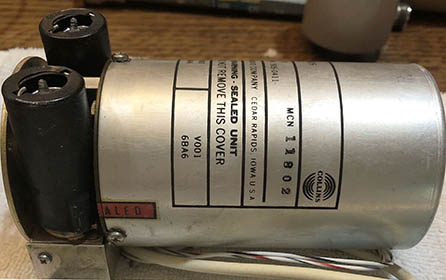
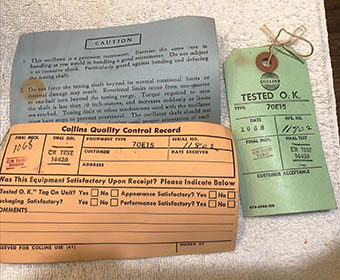
An Even Later 70E-15
PTO - This NOS 70E-15 PTO turned up on
eBay on June 14, 2023. What is important about this PTO
is that the Tested card and QC record card were included
(and photographed.) The PTO serial number is shown on
the PTO as 11802. It's also shown on the cards as Mfg.
No. 11802.
What's very interesting is the date,...1068. This is a
date code that indicates the 10th week of 1968, or from
about the first week in March, 1968. The serial number
11802 is 525 units higher than 11277 shown above. This
seems to confirm that 11277 is from the "mid-1960s."
It's also interesting that 525 units earlier and the
70E-15 PTO was still using the old original style orange
label but by 11802 a new style transparent label (or
silk screening) was being used. Note the serial number
is an ink-stamped number. Also note the Collins
"Meatball" logo. Also note the prefix "MCN"
that's part of the silk-screen label. The TESTED O.K.
card has 11802 shown as the Mfg No. and the acceptance
stamps have "C.R. TEST" (one would assume "Collins Radio
Test.") NOTE: One of these types of PTO (labels) is installed in 51J-4 SN:6977 but unfortunately the SN of the PTO isn't visible in the photograph. This 51J-4 also has S-line knobs installed. But several other higher serial number (>7000) with the typical orange Collins label have also been seen, which implies that SN:6977 probably had its original PTO replaced. |
|
| The Argument for "M" and "C.R."
Having Specific Serial Number Blocks
- An interesting anomaly can be seen in the 1953 R-388 PTO sn: M3308 (shown above
upper right) compared to the 1956 51J-4 PTO with sn: 3115C.R.
(shown above lower right.) It appears the earlier receiver has a
later PTO if just the "numbers" are used. It's interesting that the actual serial numbers of these two PTOs are separated by only 192 units and yet 3308 has the "M"
prefix indicating it was for a R-388 and 3115 has the "C.R."
suffix indicating it was for a 51J-4. It seems probable that "M"
and "C.R." PTOs each had their own blocks of numbers. Another
interesting comparison is between the 1953 R-388 with PTO sn
M6897 and the 1960 51J-4 with PTO sn 6667CR. Again, this comparison
seems to further indicate that "M" PTOs used their own block of
numbers and "C.R." PTOs used their own block of numbers.
51J-3 70E-15 PTO "no prefix/suffix" Serial Number block - The 51J-3 typically used a 70E-15 PTO with a serial number that didn't have either a prefix or a suffix, just numbers. The three confirmed 51J-3 serial numbers with PTO serial number information have SNs of 945 and 5991. A third 51J-3 SN: 2224 has the PTO SN: of 753. Another 51J-3 SN:1999 has a PTO SN: 5487C.R. however this PTO is a Collins-installed replacement using a 51J-4-era PTO. The range of PTO SNs used in known 51J-3 implies that those PTOs had their own roster of serial numbers to draw from. One would think that if the removal of the hex-plug for PTO calibration allowed air-moisture contamination was responsible for the excessive EPE problem in 70E-15 PTOs, then the 51J-3 PTO, being a civilian receiver that was probably never had its PTO calibrated, should behave like those found in the 51J-4. However, 51J-3 Collins Mfg SN:1999 had its original PTO replaced in the late-1950s and this was probably due to an excessive EPE since the rest of the receiver is original and in immaculate condition. I haven't been able to test an original, "no prefix/suffix" 70E-15 to confirm whether its EPE is similar to typical "M" PTOs and due to ferrite core contamination, or, if the PTO is like the "CR" versions with the RC34 ferrite core. A 51J-3 SN:2224 has a PTO SN:753 has been purchased in Jan 2026. Once I have this receiver functional, a PTO EPE test should be very informative. Results coming soon,... The 70E-15 SN: 945 from the 51J-3 with Collins production number 6636 is shown to the right. More details on how to correct excessive EPE in the PTOs is in the section "Reworking the 70E-15 'M' PTOs" further down this page. |
|
|
A 70E-15 in a 51J-2?
More 70E-15 Info - Here's a photo of a 51J-2 receiver with a 70E-15 PTO installed in place of the original 70E-7A PTO. Note a couple of interesting things about this 70E-15,...first, the serial number is 72. It must have been among the first ones made. Next, note that there isn't a "M" prefix or a "CR" prefix. The final interesting point is this particular 51J-2 receiver was a Collins Laboratory receiver. It has the light gray front panel. It also has the Collins asset number engraved on the upper right corner of the front panel. There's no question that Collins performed this upgrade of installing the 70E-15 PTO into this 51J-2 receiver. The serial number of the 51J-2 receiver is 650. Also note that the MC dial drum doesn't have the green striped amateur bands but who knows when that was replaced? And by whom? |
|
|
70E-15 PTO - Calibrating and, if necessary, Fixing End-Point Error Problems A lot has been written about the uncorrectable end-point errors found in the 70E-15 PTO. Unfortunately, a lot of what has been written has turned into a misleading urban-legend that ALL 70E-15 PTOs will require modification to meet specifications today. Bill Orr's famous 1969 article was specific that his correction/modification was for R-388 receivers. Orr didn't go into the PTO serial number suffix and prefix identifications but the article's reference to R-388 receivers does imply that Orr was working with the 70E-15"M" PTOs. The following information covers the "calibration" of the 70E-15"CR" PTOs found in 51J-4 receivers. These "CR" PTOs usually only require an adjustment of L002 for calibration to meet specifications. Also, I've included a lot of details on getting into a 70E-15"M" PTO that might need to have "the Orr fix" in order to meet specifications. Also included, some of the pit-falls that happen when "the Orr fix" is incorporated into a "M" PTO. |
| There's no "Easy Way" to Calibrate the 70E-15 PTO,
even the "CR" types -
There's really no easy way to work on the 70E-15 PTO. The receiver's
mechanical
design purposely made any casual attempts at accessing the PTO
calibration trimmer impossible. The only way to access L002 trimmer
is to disassemble the receiver to dismount the PTO,...and that's NOT EASY. Here are the
steps necessary: 1. Set
the receiver frequency to exactly mid-scale MC and 0.00kc. Remove
the top and bottom covers from the receiver. |
|
|
|
|
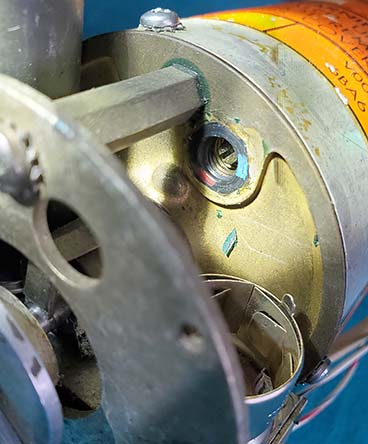
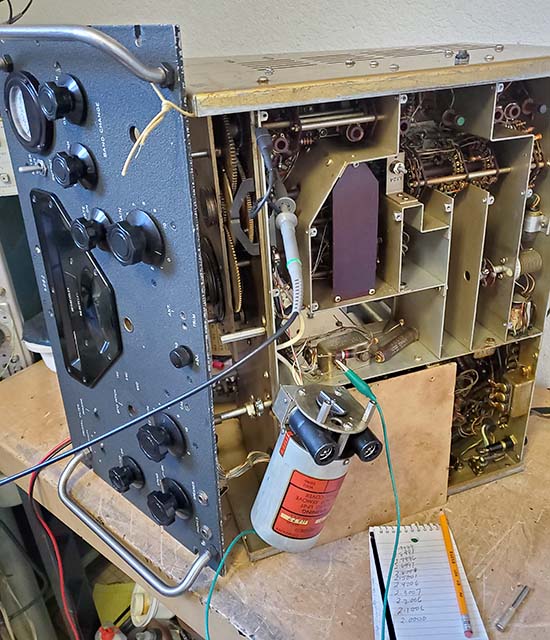
Next, adjust L002 one turn clockwise and observe the PTO output f. Adjust the PTO output f to 2.500mc. Use a Q-tip dampened with denatured alcohol to remove the index line that's marked on the PTO frame and mark a new index that aligns with the index line on the Oldham coupler (with the PTO output f at 2.500mc.) Each time L002 is adjusted it will change the relationship of the PTO shaft position to the output f somewhat so a new index reference is needed. Perform another EPE test. If there is an improvement then you've adjusted L002 in the right direction (usually clockwise will reduce the EPE.) If the EPE is worse, you have to adjust L002 in the opposite direction (go two full turns in the opposite direction.) But, usually clockwise is the right direction. This procedure is repeated until you can't really adjust L002 for anymore EPE improvement. With most "C.R." 70E-15 PTOs that have an EPE of <10kc, the error can be adjusted out just using L002. I think that the difficulty in extracting the PTO out of the receiver prevented a lot of tampering, especially with the "C.R." versions that were in 51J-4 receivers. It's not uncommon to find that a 51J-4 PTO has never had L002 adjusted and the hex nut will still have green Loctite holding it in place (of course, the vacuum is long gone.) This difficulty in getting to the L002 adjustment has probably saved a lot of 70E-15 PTOs since the vacuum seal was maintained for much longer than the typical "M" PTO. Now all that will be required is to adjust L002 for a <1kc EPE. All achievable with "C.R." PTOs. |
|
Is This the Easiest Way to Cal your 70E-15?
- You can easily test the EPE while the PTO is
still mounted in the
receiver. It's much easier that way,...then you'll know what to expect. If
the EPE is low, like <4kc to 10kc, adjustment of L002 is probably all
that's required. If that's the case, then just dropping the PTO out of
position and
leaving the wires connected is probably the easiest method for EPE
adjustment. Of course, you still have to reassemble the receiver
afterwards, don't you?,...that's the real pain. Figure about 1 to 1.5
hours to
disassemble the receiver, 15-30 minutes to cal the PTO and then another
1 to 1.5 hours to reassemble the receiver and another 30 minutes to one
hour to realign
everything. Be sure to return the PTO to 2.500mc output f and put the
hex plug back in covering L002 before
reinstalling the PTO. Also, be sure to install the KC dial before you
remount the front panel. Be aware that reinstalling the PTO might require loosening
the gearbox side Oldham coupler face to allow the alignment of the two
Oldham faces with the center section installed. After installation, the
gearbox side Oldham coupler face is adjusted to allow the PTO output at
2.500mc to agree with the MC dial at midpoint and the KC dial at 0.00
(set the KC dial last.)
Also, there should be a very slight clearance in the Oldham coupler
pieces, otherwise binding when tuning the receiver is likely to happen.
If the receiver has been recently aligned and the disassembly for PTO
calibration was carefully done, the Oldham coupler will probably only
need a slight movement to have mechanical alignment with the PTO side of
the Oldham coupler and the gearbox side of the Oldham coupler can be
moved into alignment using the KC tuning. Just "snug-up" the set screws
on the Oldham coupler and the KC dial,...they don't need to be
"over-tightened." Be aware that sometimes you'll find that the
set screws in the Oldham coupler and the KC dial hub have been coated
with green Loctite that makes loosening them next to impossible. You
have to use a small soldering iron with a long tip that can access the
set screws without contacting other parts of the receiver. Place the
soldering iron tip directly on the set screw socket. Use the heat to
soften or melt the green Loctite. This will work. These parts, the
Oldham coupler and the KC dial, MUST be moveable to perform the receiver
calibration accurately. Why was the green Loctite applied? Unknown. But,
heat will soften Loctite to the point where the set screws can be
loosened. There are more details on doing "powered by the receiver" 70E-15 "CR" PTO calibration in Part 4 of this web-article in the section "Refurbishing the Collins Laboratory 51J-4 SN:4723" with some of the other minor issues that might "crop-up" when disassembling or reassembling the receiver. The photo of SN:4723 is similar to the photo above (which is the 51J-3 converted to a 51J-4 SN:5282) but shows the extra parts that are in the PTO bay only in factory-built 51J-4 receivers. This "CR" PTO started out with about a 4kc EPE and was calibrated to <1kc EPE with a linearity deviation of <1kc,...just using L002 adjustments. If you're going into a R-388 70E-15 "M" PTO you might find that the EPE is in excess of 10kc or maybe even 12kc or more,...perhaps L002 won't be able to reduce the EPE to your satisfaction. Remember that the "M" version is the older type that might have gone through military depot calibrations,...maybe multiple times. Air ingression and internal contamination is almost a certainty. That contamination has probably allowed a "M" type of PTO to "age" differently than the newer "C.R." versions. If your "M" PTO won't calibrate with just adjusting L002, the following is what to do then,... |
|
|
Correcting an Excessive End-Point Error
in a "M"
70E-15 PTO - The
70E-15 PTO tunes from 3.0mc to 2.0mc in ten turns. There is a trimmer
inductance (L002) provided to adjust the end-point error. The end-points
on nearly every R-388 PTO are excessive and beyond the range of the
trimmer inductor. Usually, if the EPE is greater than 10.0kc (typical is
8kc to 12kc) it will be out of the range of the adjustment. One
important thing to observe is the PTO serial number. If the PTO has "M"
as a prefix to the serial number, that PTO was for a R-388 and very
likely that PTO will have excessive EPE problems - probably due to PTO
vacuum loss and excessive heat build-up from 24/7 operations. However,
if the PTO has "C.R." as the suffix to the serial number, that PTO was
for the civilian 51J-4 and more than likely the EPE can be adjusted
normally. Even though the "C.R." PTOs seem to be better, still most are
going to require adjustment of the L002 trimmer if your goal is for
perfect tracking. While the 51J-4 PTO may have 4kc to 6kc EPE which is
correctable adjusting L002, a R-388 might have a >10kc EPE which
might not be correctable with L002. PTO M11254C.R. (a
fifties vintage PTO most likely removed from a 1957 contract R-388) was initially
tested and found to have 15kc of EPE. Just adjusting L002, I was able to
reduce the EPE to 1kc and the linearity was about 1kc. Certainly
unexpected but the hex nut still had Locite on it indicating that L002 had never been
adjusted before. So, be sure to
ALWAYS try adjusting L002 first before jumping into modifying the PTO
design.
All 70E-15 PTO end-point errors (EPE) are similar in that the tuned range, which should be exactly 1.000mc change in exactly ten turns of the PTO, has decreased. I've never encountered a 70E-15 PTO where the EPE actually has an increased range. The EPE issues are probably related to the type of the ferrite core material used in the 70E-15 in combination with 24/7 operations and loss of vacuum that most R-388s were subjected to. Since the ferrite has had about 70 years to age and since nearly all 70E-15 "M" PTOs have been "unsealed" for decades one would think that the ferrite degradation would have stabilized by now. Unfortunately, it appears that the unstable nature of the ferrite core is ongoing and nowadays even the C.R. versions used in 51J-4 receivers are commonly found with excessive EPE. Aging, a lack of a vacuum environment causing air contamination, former 24/7 use, heat,...on and on,...it all seems to have an effect on the ferrite core in the 70E-15 PTO. Perhaps the changes in the ferrite core might have slowed down a bit,...not likely,...but maybe it's possible,...then by modifying the trimmer inductor for a different range (but less span,) correcting the EPE for the ferrite core condition as it is now could be accomplished. |
| Use a Digital Frequency Counter - When the R-388 was being produced, used and maintained there wasn't an easy way to directly measure the output frequency of the PTO. Much of the calibration and alignment procedures for any 51J receiver are burdened with cumbersome details on how to use the 100kc crystal calibrator and its harmonics or how to use heterodynes to assure proper frequency output, sometimes even another calibrated receiver was used. As far as that being "the good old days," just read through any 51J procedure and see how much of the procedure is dedicated to just setting up these implied reference signals for calibration. Nowadays we have Digital Frequency Counters that can measure the PTO output directly, and that measurement is accurate and instantaneous. I started using a DFC when doing R-390A PTOs and found the process is so direct and so easy that I've started using the same method to do the 70E-15 and the 70E-7A PTOs for the 51J Series. It makes setting up the KC dial synchronization quick, calibration of the PTO EPE is quick and easy (unless the PTO came out of a R-388) and the accuracy is the best. You'll have to read through the procedure to determine what needs to be accomplished and almost anything requiring frequency determination is about ten times easier if a DFC is used to measure the frequency directly. I sometimes use a 10X oscilloscope probe to isolate the measurement load from the circuit if I'm measuring an oscillator directly. |
| L002 Details
- It was common to find the 51J-4 receivers with virtually no EPE in
their "C.R." PTO but that's changing as ALL of the PTOs age more and
more. Nowadays, it's fairly common that 51J-4s will be found with an EPE
of about 4kc to 8kc but that can usually easily be adjusted-out with the trimmer L002.
If your R-388 "M" PTO has excessive EPE, that is >10kc EPE,
it still might be possible to correct the EPE with just adjusting L002.
ALWAYS try to adjust L002 first before modifying the design. I've been
able to correct EPEs as far out as 15kc with just adjusting L002 (it
depends on the PTO - that one was a "C.R." type.) But,
if no adjustment of L002 results in a reduction of the EPE then correction
will require removing one coil turn from the internal PTO trimmer coil
L002. This requires removing the PTO from the receiver and then
disassembling the PTO. When modifying the trimmer coil, be sure to
remove only one turn. This coil only has four turns so one turn
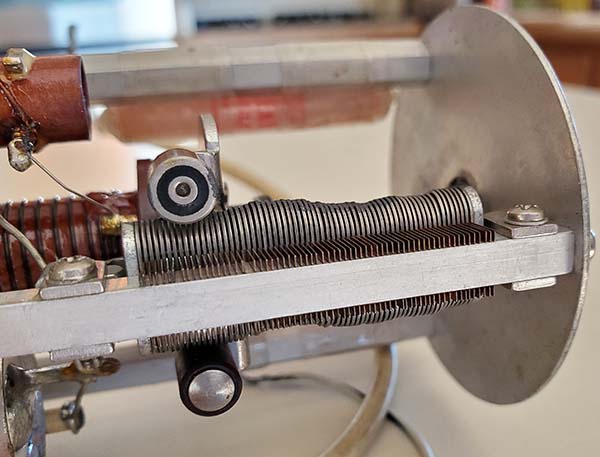
is quite a bit (also the coil wire is quite small at 29 gauge.) As can
be seen in the photo to the right, access to L002 is very easy once the
PTO shield-cover has been removed. If more than one turn removal seems
necessary in order to get the EPE in spec, you can perhaps remove
another quarter to perhaps a half of a turn - but no more. The object of
reducing the L002 inductance is to skew the adjustment range to where it
will compensate for the ferrite changes. But, as the range is moved the
span of adjustment is greatly reduced. Taking off 1.5 turns reduces L002
to just 2.5 turns and that might narrow the span of the adjustment range
to the point where adjustment of the slug has no effect the EPE at all.
Remember, the removal of one turn should be sufficient to move the
compensation frequency but it severely narrows the adjustment
range,...be careful and test "one turn" thoroughly before going any
further.
Bill Orr wrote extensively about the R-388 and correcting the 70E-15 "M" PTO EPE problems in the form of an article in Ham Radio magazine in the December 1969 issue. This detailed article should be read before attempting to rework your first 70E-15 "M" PTO. Orr's article can be found online in PDF form on the Collins Collector Association website - www.collinsradio.org Additionally, Dallas Lankford, in the Hollow State Newsletter, wrote several articles about the 70E-15 PTO and the "Orr fix" problems that he ran into. Basically, Lankford felt that Orr had just ignored the linearity of his modified 70E-15 PTOs since he doesn't mention it in his write-up. Lankford provides a lot of data and graphs on the 70E-15 PTO EPE range and on its linearity after the Orr fix,...more in the next section. The Hollow State Newsletters that relate to the R-388/51J receivers can be found on www.navy-radio.com website. |
|
| Unintended Linearity
Problems
- The linearity for the 1000kc range, or the 3.00mc to 2.00mc range, is
determined by the adjustment of the "Corrector Mechanism" which is
essentially a compressed "stack" of washers upon which an extension arm
from the ferrite core rides. The slight "ups and downs" of the
individual washers in the "stack" will slightly change the position of
the ferrite core and thus create a "correction" for slight changes in
the linearity as the ferrite core travels its 1000kc range. Normally,
the original factory setting will be maintained if the EPE is corrected
just using the stock L002 adjustments since that implies that the EPE wasn't too far out to begin with.
However, if the EPE is
significantly more than 10kc and the EPE can't be reduced with L002,...AND THEN L002 is
modified by removing one turn from the coil, now the different
inductance of L002 will skew where physically the core is positioned
within the main inductor when 2.5mc output f is attained. This
different physical position is what affects the linearity since now
exactly where and how the ferrite core extension arm tracks is in a
different section of the washer stack. And, since the "ups and downs" of the
washers are now in a different relationship to the PTO output f,
the former linearity adjustment won't allow the ferrite core to
track correctly. Changing the "stack" will be necessary for readjusting the
linearity to match the PTO tracking as it is now, that is, after the PTO L002
modification for EPE
correction. It can
be tedious work that might easily lead to frustration. Be sure to adjust
the EPE first and then do the linearity set-up. Be sure to mark the stack for the beginning and the end of travel
of the extension arm
for the 1000kc range before adjusting any washers. Test the linearity and mark down
the PTO output f range where the
corrections need to happen. Then set the PTO at that point and remove
the cover to see where the corrector arm is on the washer stack and where
the adjustment is needed. Once you remove the PTO cover, all tracking is
affected and to check adjustments requires putting the cover back on.
The "back and forth" of putting the shield on and off is one of those
repetitious necessities when performing linearity adjustments.
Back to the stack,...if other washers in other sections move while doing the correction,...that's a problem. But, the stack has brass separators between each washer to allow moving individual washers. The stack is under compression to hold adjustment and making changes requires loosening the compression screw just enough to allow adjusting one washer at a time where needed and not moving any of the other washers in other sections. The separators will allow moving just one washer if you're careful and the compression is "loosened just enough." The screw for loosening the stack is accessed through a hole on the back of the PTO rear circular support piece. Unless you are used to performing delicate mechanical operations, these linearity adjustments are tedious and require patience (probably why Orr didn't bring it up.) |
|
|
NOTE on Linearity: Dallas
Lankford wrote extensively in the Hollow State Newsletter about the need
to do the corrector stack linearity adjustment if the EPE was more than
4kc,...meaning that after > 4kc EPE was corrected by the removal of one
turn on L002, then the linearity
would also require adjustment (Lankford was seeking perfection.) Certainly, the farther out the EPE is the
more the linearity will
be affected once the EPE is corrected. But, always do the EPE adjustment
first, then see where the linearity
has gotten to. Remember, just using L002 to calibrate a typical EPE in a
"CR" PTO won't affect the original linearity adjustment. The linearity problem is
in modifying the inductance of L002 which significantly changes the
physical position of where center-span (2.5mc output f) is in
relation to the linearity corrector washer stack. Lankford was trying to achieve the original specification
of <750hz linearity error over the entire 1000kc range which is a pretty
tight spec. Keep in mind, this linearity problem only applies to "M"
PTOs that have had the "one turn removal" on L002. It's been
my experience that the typical 8kc EPE error found nowadays in
"C.R." PTOs can be
adjusted out with a calibration just using L002,...usually cal'd to around 1kc
EPE with a linearity deviation of about 1kc.
Not spec, but close enough.
The upshot of this is,...if you feel that correcting an EPE problem
requires the "one turn removal" mod to the PTO, expect a few other
problems to show up. It's never as easy as it sounds. |
| The Special "Unlocking" Tool Required
for the 70E-15 EPE Adjustments
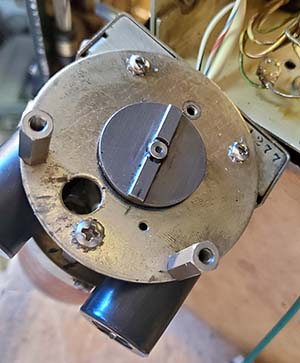
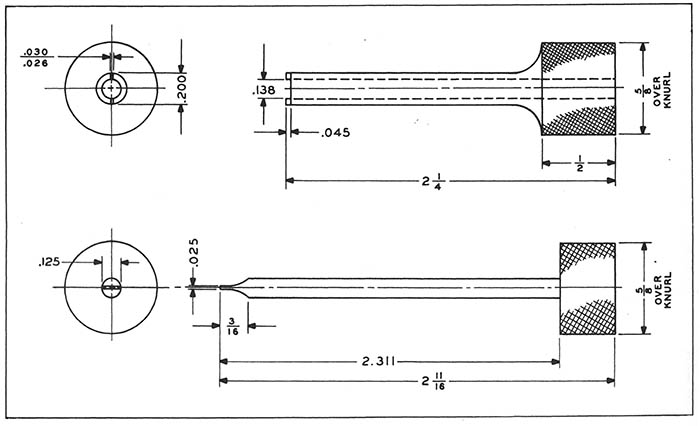
- The end-point adjustment is behind a hex-head plug that has to be
removed and then there is a slotted locking collar-nut that also has to be
loosened before the slotted shaft on the trimmer inductor adjustment can be moved. The tool
required to loosen the locking collar-nut wasn't supplied with the receivers,
but a drawing with dimensions was generally included in the manuals
showing how to make the tool (the drawing to the right is from the 51J-4
manual.) The unlocking part of the tool is a small round cylinder with
two small projecting tangs that will mate with slots in the locking nut.
The blade screwdriver part of the tool fits down the barrel of the
cylinder part of the unlocking tool to allow adjusting the L002 trimmer.
The cylinder tool kept the locking nut from moving while the L002
trimmer was adjusted. After the EPE was "in spec" then the locking nut
could be "snugged-up" but not over-tightened. I made my own tool out of
steel thin wall tubing about 2.5" long and .20" in diameter with one end
filed to create the two tangs necessary. Since it's made out of tubing,
a small thin blade screwdriver fits down the barrel and can make the
adjustments. Easy to make. The drawing to the right gives you an idea of
how the tool works.
There are some restorers that have built special right-angle tools for accessing the locking nut and the trimmer inductor with the PTO still mounted in the receiver. I've heard of these tools but haven't ever seen them. Certainly, some manual dexterity and a lot of patience would be required for successful use of these tools. Even then, with each adjustment of L002, the KC dial would need to be reset on its shaft to 0.00 at mid-scale with a 2.5mc PTO output f. I think it's easier and more advantageous to just dismount the PTO from the receiver leaving it wired to the receiver for initial inspection and testing. Who knows if someone in the past tried to adjust the EPE without "unlocking" it and has gnarled the trimmer slot. If you have the PTO dismounted from the receiver you can visually examine the trimmer slot and make sure it's not damaged. Generally, if the PTO is the "M" version, it has to be completely removed (wires disconnected) from the receiver for modification of the trimmer inductor for end-point correction. |
|
|
Who Needs a PTO Test Jig? - Orr's Ham Radio article shows his fixture using the KC dial but you don't really need to be that elaborate. Also, depending on the fixture design, using the KC dial might cover the access to L002. Then the KC dial has to be dismounted from the PTO for each adjustment and then remounted for testing (it's not that difficult to dismount the KC dial for each L002 adjustment and the KC dial has to be "re-zeroed" after each adjustment anyway.) But, for the quickest and the easiest "test jig" you can get by with an ink reference index line on the PTO frame and another ink index line on the rim of the Oldham coupler. Be sure to use water soluble ink because the frame index line has to be washed off and the index line moved to compensate of the L002 adjustment. I've also used a fine line Sharpie and then just use a Q-tip and denatured alcohol to remove the index lines as needed. You'll have to count the ten turns the first time to be sure that the range is close to 2.000mc to 3.000mc but, after the first time, then just watching the output frequency is all that's necessary. How accurately you observe your index lines during the adjustments will determine your overall accuracy when the PTO is installed back in the receiver. You just need to determine a 1000kc change in frequency for exactly ten revolutions of the PTO shaft and a couple of index lines will do that. The PTO should tune exactly 3.000mc to 2.000mc in exactly ten turns of the PTO shaft and that should correlate to 0.00 to +00.0 (one complete turn) x 10 on the KC dial (when installed back in the receiver.) If working on the PTO on the bench, I use a bench power supply connected to the PTO wires with clip leads. Voltages required are +150vdc, 6.3vac and negative-chassis ground. A digital frequency counter monitors the PTO output using the PTO output coaxial cable. In this way, the PTO can be completely removed from the receiver. It makes any rework (like modifying L002 trimmer inductor) much easier since you don't have to have the harness connected to the receiver. When measuring the PTO output frequency for EPE adjustment be sure to have the PTO shield-cover in place as its proximity to the PTO circuitry greatly affects the output frequency. Don't worry about the seals for the PTO cover. At the factory, when a PTO was completed, that is EPE adjusted and it was "ready to go," the PTO was heated, then, while still hot, the L002 hex-plug was installed. As the PTO cooled, it formed a slight vacuum inside which protected the components. But, the first time someone decided to adjust the EPE, the seal was broken and the vacuum was lost. That's why Collins didn't want anyone working on their PTOs since, at Collins, after any adjustment or rework, the PTO again went through the process to create the slight vacuum inside. Collins claimed that correcting the EPE in the field was only for temporary repairs and the PTO needed to be sent back to Collins as soon as possible because the loss of vacuum followed by air-moisture ingression would cause rapid deterioration of the internal components. Hmmm, hype? Well, the evidence is all too apparent nowadays that loss of vacuum was what Collins suspected as the cause of the PTO problems. Nowadays, nobody worries about the vacuum loss in the PTO because that certainly happened a long time ago anyway. The components inside have already "aged" and are probably stable,...well, maybe. Besides, we all take excellent care of our receivers and the environment they are kept in is usually very clean and temperature-controlled,...isn't it? Summary - If all you need to do is to adjust the EPE (like on the 70E-15 "C.R." types) it's still not an "easy job" to dismount the PTO. You have to lower the front panel and the KC dial has to be removed to access the three PTO mounting screws, but leave the PTO wiring connected to the receiver to supply the voltages (there's a lot more involved in getting access to the PTO L002 - it's NOT an easy job.) Attach a 'scope 10X probe to the PTO output coax and connect the probe to a digital frequency counter. Removing the hex plug for the access hole for L002 will require pulling V001(Osc Tube) to be able to get a 3/8" open-end wrench on the hex plug. If it's the first time L002 has been adjusted, the hex plug might be held in place with green Loctite. Be sure to use the correct "unlocking adjustment tool" for the L002 trimmer. I use felt pen index marks on the Oldham coupler and the PTO frame. Not too difficult and relatively fast if all you need to do is an EPE adjustment. This method might not be as accurate as using the KC dial but if implemented carefully, the results will still provide 1kc accuracy,...and you don't have to waste time building a test fixture. |
| Reality Check,...The Necessity
of Doing the One-turn Removal Modification on L002? - After all that has been
written about doing the Bill Orr one-turn removal on the trimmer L002, I
have to wonder,...why? Is it worth it? Removing the PTO from the
receiver is difficult and requires quite a bit of receiver disassembly
and reassembly afterwards.
Unsoldering the three wires and coax shield requires dealing with MFP coatings plus having a good soldering technique and quality
tools.
Getting into the PTO is pretty easy after that. But, careless or
clumsy workmanship can lead to
component damage. Sometimes removing one turn from L002 won't result
in a perfect EPE and removing more turns will result in a PTO that
can't be adjusted. The further the EPE is out, then linearity problems
will be encountered after the EPE correction is
performed. Most
70E-15 "M" PTOs have about 8kc to 10kc EPE error in 1000kc! An EPE of
10kc is an error of of 0.1% - not that bad. If you set up the PTO at 2.5mc and centered
on the MC dial and 0.00 on the KC dial, the EPE is spread from the
center to end is 5kc on each side of center which isn't bad and
quite correctable with the dial fiduciary. Unless you're really an OCD-perfectionist
or you use your R-388 receiver as a frequency meter, the work
involved along with the risk of potentially serious damage
being the result of tampering with the internals of the 70E-15 along
with the collateral damage from pulling it out of the receiver and
then reinstalling it, you
might really want to put the slight 0.1% error into perspective. I
don't usually do the L002 one-turn removal because most of time it's
unnecessary with "CR" PTOs that can be
calibrated to <1kc EPE just using the L002 trimmer adjustment and the typical "M" PTO "as is" will have
about a .1% error and that error is usually easily
correctable using the KC dial fiduciary if the PTO is set up to
2.5mc output f at center band. There is one concern when aligning a receiver with a PTO that has a significant EPE, like 10kc, for example. Since the Variable IF for both the odd and even IF sections is aligned at the band edges, there will be a slight but noticeable error when adjusting for peak at both band ends. To compensate for the EPE during the Vari-IF alignment, set the receiver to the designated frequency, for example 1.600mc but you'll have to set the RF signal generator to approximately 1.595mc but "rock" the RF generator dial for the peak response. Then adjust the three L-trimmers marked 1.6. The go to 2.4mc and use the same method of setting the receiver to the required frequency but adjusting the RF generator for peak response and adjusting the three C-trimmer marked 2.4. Of course, this isn't the best way to align the Variable IF but, since the EPE does skew the band edges, this procedure compensates for that,...a little anyway. Naturally, the best approach is to correct the PTO calibration before doing the Variable IF alignment. Maybe it depends on how much of an OCD-perfectionist you happen to be. This example of calibrating for a 5kc error at the band edges of the Variable IF is not even noticeable as far as having an effect on sensitivity (but those of us with an OCD-perfectionist problem notice that sort of thing.) Try This PTO Set-up Before Digging into a "M" 70E-15 - I suggest trying this set up,...first,...don't dismount the PTO,...it can be tested and aligned while mounted and operating in the receiver. Attach a digital frequency counter on the output of the PTO and set the PTO to exactly 2.500mc output (use a shielded cable or a 10X 'scope probe.) Then check to make sure the MC dial is in the exact center of its span (6.0mc, for example, it doesn't matter which MC Band the receiver is set to.) Then mechanically set the KC dial (loosen the Bristol set screws on the KC dial's hub) to exactly 0.00 (make sure the fiduciary index is straight-up) and then carefully snug-up the set screws. Rotate the KC dial a half-turn and then reset to exactly 0.00. Verify that the PTO output is still at 2.500mc exactly and the KC dial is exactly 0.00. Now perform the remaining front end alignment (Vari-IF and RF tracking.) This will result in the best possible tracking taking into account the PTO output will only be "dead-on" at the center of the MC dial and the error skews off as the dial is tuned from center in either direction. In this method, the noticeable EPE is mostly at the ends of the dial and it's actually only half of the total EPE since the reference is at the center of the PTO span (instead of "end-to-end.") This results in the best tracking where most of the listening is actually done. Fast and easy. |
|
Other 51J Oddities |
|
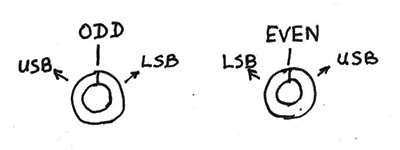
Break-in Operation for the R-388, 51J-3 and 51J-4 - What a Headache! - Perhaps the most inconvenient requirement for the R-388, 51J-3 or the 51J-4 is how to provide the Break-in function. Break-in requires an external +12vdc 200mA source that is switched "on" when in the "transmit" mode to isolate the receiver input and to mute the audio output. Inside the receiver, relay K101 is operated by the Break-in voltage and the relay contacts disconnect the antenna input line, ground the receiver input circuitry and also remove the voltage from the IF amplifier plates to mute the receiver. There is also a neon bulb as a protection device on the antenna line but this is mainly a static voltage drain and not intended to handle large amounts of RF energy. Break-in should be used when the receiver is paired with a transmitter and both are using the same antenna switched by an external T-R relay. Usually, the T-R relay does provide positive isolation and many Dow-Key T-R relays had an additional spring-loaded contact switch inside the receiver-side coaxial fitting barrel that further increased receiver isolation. These types of T-R relays afford protection when used with the Standby position for muting in the short term and it's fine for testing and preliminary set-ups but, ultimately, the permanent set-up should be using the Break-in with the T-R relay to provide a positive "double" disconnect of the antenna line and providing the grounding that protects the receiver input,...just in case there's a T-R relay failure and arcing happens inside the relay. IMPORTANT NOTE: The front panel STAND BY position does not actuate the Break-in relay. The Break-in relay can ONLY be operated by applying +12vdc Break-in voltage to pins 2 and 3 of the REMOTE terminal strip (pin 1 provides a ground for a cable shield.) NOTE 1 - If you can't use an external +12vdc for Break-in: There are a couple of methods that provide the +12vdc "Break-in" within the receiver. Either a small power supply mounted under the chassis of the receiver or a voltage doubler circuit that runs off of the 6vac tube heater supply. Since < 200mA is required to operate the relay K101, very small components can be used for either power supply circuit. NOTE 2 - For an easy external Break-in voltage - It's possible to use a +12vdc "wall-wart" type of power supply for the Break-in voltage. Use the T-R relay auxiliary contacts to switch the +12vdc. Or, if the "wall-wart" is RFI noisy, switch the AC to the "wall-wart" using the T-R relay auxiliary contacts. NOTE 3 - The 51J-1 and 51J-2 have conventional stand-by provisions providing external relay connections that parallel the front panel STAND BY switch. The auxiliary contracts on the T-R relay can provide the remote Stand By function. There isn't any antenna coil input protection circuitry provided in these early version receivers. BFO/IF "Inversion" - Selecting Upper or Lower Sideband with the 51J - The double conversion process in the 51J circuit involves mixing the incoming RF with a Crystal Oscillator (using fundamental and harmonic frequencies) to create Odd and Even Bands for the dual Variable IF that are in turn mixed with the PTO output. The PTO tunes from 3.0mc to 2.0mc but the Even Bands use the Variable IF that tunes from 1.5mc to 2.5mc. This requires using the formula PTO f - Vari IF = +500kc fixed IF (mid-range example 2500kc-2000kc=+500kc.) However, an Odd Band uses the Variable IF tuning 2.5mc to 3.5mc and this requires using the formula PTO f - Vari IF = -500kc fixed IF (mid-range example 2500kc-3000kc= -500kc.) The 500kc fixed IF signal is actually changing phase (180º) between Odd Bands and Even Bands. Since the BFO is a 500kc oscillator heterodyning with that 500kc IF, when the 500kc fixed IF phase changes, the BFO phase relationship inverts. This shows up, for example, as tuning in an USB 14.200mc SSB signal will require the BFO to be to the right of the center index line for proper demodulation. But, if an USB 15.035mc SSB signal is tuned in then the BFO must be to the left of the center index line for proper demodulation. Since there aren't any calibration index lines to comprise a scale for the BFO position, the 51J design never intended using the BFO for selecting a specific sideband nor in providing a "calibrated position" for the BFO (as with the later R-390 and R-390A.) It's really not that much of a problem but it's something that's noticed quickly when first operating a 51J receiver nowadays and tuning in SSB signals.
Even Collins had a hard time with the Odd-Even Band changes and the relationship with the BFO operation. When the 51J was designed at the end of WWII, a BFO was only used for CW reception and, since a CW signal has no sidebands, the position of the BFO didn't matter as long as it provided a heterodyne. By the time the 51J-4 was introduced, SSB had been developed and was being promoted by Collins. The 51J-4 manual has a specific set of instructions for determining what Collins thought was the proper setting of the BFO for SSB signals when using the J-4. The procedure requires determining center frequency of a marker signal and then tuning below the f center for a carrier level drop of 18db and then adjusting the BFO CCW for zero beat and noting the knob's index position. The same procedure is again performed with by tuning above f center for an 18db drop and tuning the BFO CW for zero beat and noting the knob's index position. NOTE: It's strange that the Collins instructions actually states the signal levels and the signal drop as "3 S-units" and, of course, all of the 51J-4 receivers had Carrier Level meters that read in "db over" but Collins did provide the 18db level in parentheses. The instructions finish up by stating that if the SSB signal can't be demodulated with the BFO in the proper CCW position then rotate the BFO control to the proper CW position. In other words, there's no specification of either "upper" or "lower" sideband mentioned since obviously that changes depending on whether the band being used is Odd or Even, which isn't mentioned either. It must have become too convoluted to explain at a time when SSB transmissions were just becoming popular and just beginning to be heard on the air, so Collins avoided it altogether. It also seems strange that Collins (at the time) didn't mention the BFO inversions since this changing BFO relationship would have affected reception of RTTY FSK signals. The BFO position determines whether the RTTY FSK signal is going to be received "Mark high f" or "Mark low f." Of course, it depended on the type of RTTY TU. Those TUs that ran off of the IF and supplied their own BFO might not have been affected. However, some of the TUs were audio input types and relied on the receiver BFO. These would have definitely been affected by the Odd-Even BFO inversion but most RTTY audio TUs had the ability to invert the relationship, if necessary, for this very reason. Since the BFO inversions are a product of the Vari-IF and PTO relationship, they will be experienced with all versions of the 51J series. I guess it's just one of the 51J "oddities." Communications-grade Audio, Loudspeakers and External Audio Amplifiers for the 51J Series - If you're expecting high fidelity audio from any of the 51J receivers, you're in for a disappointment. The initial intent of the receiver was communications and especially for receiving data-type transmissions. Communications-grade audio response was generally considered 300hz to 3000hz for voice transmissions. For CW or data, the audio bandwidth could be much narrower. Most military transmitters (and most amateur transmitters at the time) that were used for voice communications kept the audio response approximately from 300hz to 3000hz. This was to assure that the best intelligibility was available at the receiving-end. Voice transmitters, if their audio response was set up to favor the lower voice frequencies, would have to lower the audio gain level in the speech amp which in turn lowered level of modulation. The voice's low frequencies have a lot of "speech power" that would easily cause over-modulation. Most amateur and military voice transmitters were fairly low power and if they were set up with "bassy, low-modulation level" audio, the signal intelligibility would be lost and copy would be difficult, if not impossible. All 51J-1 and 51J-2 receivers have audio specification of 200hz to 2500hz at -6db down. Additionally, the 51J-1 and 51J-2 have a very narrow IF bandwidth of about 4kc at -6db. The R-388, 51J-3 and 51J-4 have audio specifications of 200hz at -3db down on the low end and 2500hz at -7db down on the high end with an IF bandwidth of about 6kc at -6db and 1.5 watts available audio power at less than 15% distortion. The 51J-4 widened the IF band width a bit more than that, using a 3pf IF coupling C where the R-388 used a 2pf IF coupling C, and added mechanical filters to the 500kc fixed-IF that actually determined the band width and created a steep-sided, flat topped bandwidth that, while great for selectivity, created serious audio issues in the AM mode using the 6kc mechanical filter. Certainly not impressive audio specs from any of the 51J Series,...especially if you're an audiophile. But, the 51J receivers are "communications receivers" and their audio specifications are appropriate for that type of end-use. All of the advertising or the manuals never specified a particular matching speaker for any of the early 51J series of receivers. The 51J-1 and J-2 manuals provide dimensions of the intended loudspeaker and these dimensions describe the Collins 270G-1 (used an 8" loudspeaker.) The 51J-4 manual actually specifies the 270G-3 loudspeaker. The 270G-3 used a 10" loudspeaker. During early production there was a 270G-2 10" loudspeaker available. There is conflicting information out there (even from Collins) but it seems that the 270G-2 was identical to the 270G-3 with the exception of the three small vertically-spaced holes towards the front on each side of the cabinet for installing rack-mount brackets. Some sources say it's the other way around, that is, the 270G-3 had the rack bracket holes but the 1959 Collins production catalog shows the 270G-3 loudspeaker without the mounting holes for the rack brackets. Also, in the 1959 Collins catalog the 270G-3 is listed as 6-8Z ohms however actual impedance measurements of original loudspeakers will normally show they are 4Z voice coils. Note that this is a nominal impedance shown and that would vary depending upon how the measurement is made, specifically the frequency employed. Figure that the impedance specified is "NOMINAL" and whether the testing shows 4Z, 6Z or 8Z, all 270G-3 loudspeakers sound great when connected to the 4Z output terminals of any 51J receiver. R-388 receivers were generally used for specific military set-ups such as RTTY or other data transmissions where a loudspeaker would be part of a larger, rack-mounted collection of equipment. In addition to the rack-mounting option of the 270G-2, there also was a rack mounted dual speaker system available for diversity RTTY set-ups. There was a USN version of the R-388 referred to as the AN/URR-23-A that came in a standard Collins cabinet, CY-1235/U and included the 270G-3 speaker (mil ID: LS-199/U.) The 51J-2 was also supplied in a similar fashion and designated as the AN/URR-23 (no -A.) For a vintage mil-rad station, perhaps the easiest speakers to find (that are period and manufacturer correct) would be either the Collins 270G-1, an 8" speaker, or the Collins 270G-3, a 10" speaker. The 270G-1 was typically supplied with the 75A-1 receivers and the speaker cabinet had the Collins "winged" emblem on the front with chrome trim strips with a felt-flocked perf-metal grille (usually a sort of brownish-maroon color.) The 270G-1 also has a serial number tag mounted inside the cabinet showing the model designation and the serial number. The 270G-3 was typically supplied with the 75A-2, 75A-3 and 75A-4 receivers and these cabinets don't have the Collins WE and have black trim strips with an white-cream color felt-flocked grille. The 270G-3 doesn't have a serial number tag and wasn't assigned a serial number. Either of these Collins speakers are fine sounding, communications-grade reproducers and, though usually outrageously expensive, they are easy to find. However, any 4.0Z speaker will function fine with the 51J receivers. There's not too much of an advantage in using a high-quality, large diameter speaker installed in a bass reflex cabinet because the audio output circuitry of any of the 51J Series receivers was always "communications grade" in quality. The audio range available with all 51J receivers lacks any significant bass since the audio output frequency response was rolled-off starting at 200hz on the low end and the upper limit roll-off was at 2500hz while the audio power can only produce about 1.5 watts maximum. Even the latest version, the 51J-4, still has audio that was specified as 200hz at -3db down to 2500hz at -7 db down in the manuals with the 1.5 watts output power maximum (at <15% distortion.) These less-than-impressive specifications will become more and more apparent with better quality, high fidelity speaker systems. Using the 600Z output to drive a loudspeaker through an appropriate matching transformer is also an option. Using a good quality transformer and a typical 8Z or 4Z loudspeaker will result in typical communications audio reproduction. Whenever I've used the 600Z output to drive a 600Z/8Z matching transformer and an 8Z loudspeaker, I've found the audio to sound "thin" and not nearly as "clean" as the 4Z output. I've tried several 51J/R-388 receivers and multiple speaker set-ups and I always have the same results. With the very late R-388 receivers and all but the earliest of the 51J-4 receivers, the Diode Load was brought out to the rear chassis apron as a test point jack. It would be possible to use a shielded cable connected to the Diode Load and run that to the input of a High Fidelity audio amplifier (using the aux. input or some other fairly Hi-Z input) to drive a quality loudspeaker. You would lose the Noise Limiter function but it was designed for repetitive pulse noise that isn't heard very much nowadays. Also, the 51J-4's 6kc mechanical filter will still be limiting any high quality AM reproduction so very few enthusiasts have bothered with the external Hi-Fi amp set-up. However, it does depend upon what type of stations are listened to. AM Broadcast from local stations will sound pretty good on a J-4 if the receiver is tuned to the carrier plus one sideband allowing the audio to go up to about 6000hz (theoretically,...and since AM-BC stations are limited to a 10kc bandwidth their transmitted audio should only be up to about 5000hz,...theoretically.) Since there's no fading or phase distortion with ground wave signals, this type of reception might benefit from an external audio amplifier with bass and treble controls to enhance the audio frequency response. Any SW-BC or AM ham transmissions will be subject to skywave propagation conditions and lack-luster signal strength that usually seriously affects audio quality. Limitations on any local AM-BC would be in the program material and that's pretty much the same for any AM-BC or SW-BC. Since the 51J receivers have always been considered "communications receivers," it's not unexpected that the standard Collins communications-grade loudspeakers, the 270G-1 or the 270G-3, will give the best results when used with any of the 51J receivers. UPDATED NOTE: On the 51J driving large loudspeakers in bass-reflex enclosures - Nov 2025: I may have to modify what I said about using a 51J receiver with a large speaker not sounding very well. I've had my 51J-3 SN:1999 connected up to a 12" loudspeaker that's installed in a wall-corner-mount bass-reflex enclosure. I have the enclosure mounted up next to the ceiling which puts the speaker enclosure about ten feet away from the listening position with the bass reflex port about 6 feet off the floor. The 12" loudspeaker has an 8Z voice coil and it's connected to the 4Z output on the receiver. I've been listening to this set up for several days now and I'm surprised at how good it sounds. Some bass response,...not a lot,...but certainly some, which is a surprise. The big improvement I think is due to the distance that the speaker enclosure is from the listening position. That distance requires the Audio Gain to be increased a little bit and that helps the bass response. Also, the highs (if there are any) tend to "roll off" with the distance but the lows don't. It's a really nice sounding set up and totally unexpected for a 51J receiver. So, large speakers and enclosures can be beneficial to listening pleasure, even when using a 51J receiver. It depends on the loudspeaker's cone suspension being the older formed paper type and then the location in the room and its distance from the listener. A small table loudspeaker setting on top of the receiver directly in front of the listener at about two feet distance is probably the worst possible speaker location for pleasant sounding audio,...maybe good for weak CW or SSB signals but terrible for mellow sounding AM or music broadcasts. Cross-Modulation with R-388, 51J-3 and 51J-4 - The first receivers, the 51J-1 and 51J-2, used RF transformers in the Ant/RF input section of the receiver but this resulted in a fixed antenna input impedance of 300 ohms. The Army found this terribly inconvenient since most of their antennae were whip verticals or dipoles with impedances a lot less than 100 ohms, let alone 300 ohms! Collins modified the RF/Ant input section when implementing the changes needed for the R-388 receiver. The change removed the primary winding on the coils and just used a parallel LC for tuning the Ant/RF along with adding an Antenna Trim to allow matching the antenna low impedances better. It all works fine except if there's a really strong RF field present. This could be a nearby AM-BC station or a neighboring ham running a high power transmitter. To have a strong enough RF level that could cause cross-modulation generally requires using a very large random length wire antenna that's directly connected to the receiver antenna input. The receiver's parallel LC Ant/RF input section doesn't have much selectivity and that's why it's possible for cross-modulation to happen if the RF field is sufficiently strong. The Army used mostly whip antennae and so it wasn't much of a problem for them. I've heard about this cross-modulation problem with the R-388 but I've never experienced it. Certainly, in large urban areas where powerful AM-BC stations might be nearby and numerous, along with the possibility of neighboring hams operating powerful transmitters, the cross-modulation issue might be more likely to occur. Using an end-fed wire antenna without any type of matching network (tuner) will contribute to the susceptibility to cross-modulation. Here in Western Nevada, I've always used large wire antennae but I've always used dipoles fed with open wire feedline in combination with a selective type of antenna tuner. I believe that the "tuned" antenna, which is essentially a selective LC combination, adds another "tuned stage" ahead of the receiver to compensate for the reduced selectivity in the Ant/RF input section. Using large broad-band or untuned (non-resonant) antennae might tend to result in the R-388 being more susceptible to cross-modulation. A selective "tuned" large wire antenna seems to work for me. Also, even if I'm just listening to station outside of the ham bands, I'll always "tune" the antenna for that frequency of reception. Again, the tuning and resulting high-Q of the antenna might be why I haven't experienced any cross-modulation issues. |
|
General Information on Rebuilding 51J Receivers |
Rebuilding Difficulty
- The 51J Series are fairly difficult receivers to work on because their
construction isn't modular in mechanical design and the receivers will
need to be substantially disassembled to work on the commonly
encountered problems, including those problems involving the PTO that
was used on the R-388. The 70E-15 "M" PTO that was used in all R-388
receivers might require a slight modification of L002
inductor-trimmer to be able to reduce the end-point error to <1kc.
If work is required in the receiver's front end, it is extremely difficult to access any of the parts in the crystal oscillator section and most of the other front-end sections aren't much easier to get into. Additionally, the wires from the various coils are very fine and easy to accidentally break when doing rework in the front-end of the receiver. Most of the time it's easier to dismount the particular coil assembly for the repair and then reinstall. All R-388 receivers will be MFP'd which adds to the difficulty of rework. The 51J gearbox is complex and rework is difficult. To take on a poor condition 51J receiver, you should be experienced in complete disassembly and reassembly of advanced vintage communications equipment. You should have professional soldering equipment, be experienced and possess a good soldering technique and only use real SnPb solder. If you're going to work on the R-388s you should be experienced in reworking military equipment that has been MFP-coated. An absolute necessity for working on almost any Collins equipment is the Xcelite 99PS-60 Bristol Multiple Spline Screwdriver 11 piece set (this set includes the extension piece.) This set is expensive at $135+ but it's a "must have" to access many of the Bristol* set screws deep inside the receiver can't be reached unless you have 99PS-60 set. Your test equipment should be laboratory-type although your skill at RF/IF alignment will determine the ultimate quality of the receiver's performance. Modern test gear will make alignments much easier and much quicker. The 51J Series is within the capabilities of restorers who have good mechanical ability and a solid electronics background with considerable experience working on vintage sophisticated communications receivers. Don't be in a hurry and always be thorough. * Signal Corps manuals refer to these tools as "Bristo" wrenches. That's the only place I've seen that spelling used. Bristol is correct. |
Some Thoughts on Rebuilding
- Any of the Collins 51J-3, R-388 and 51J-4 receivers, if they have been
well-cared-for, will usually operate as found.
However, these receivers are probably not operating to their full capabilities
and generally give the new owner a feeling that the 51Js are over-rated. Although
you won't find handfuls of bad capacitors (as in the early Hammarlund
SP-600s) there are several common problems with the 51J receivers now
that they have aged for the past seven decades. Probably the most
important step is to install good condition tubes and to perform a full IF/RF
alignment. These two steps are always required for top performance and the new tubes should be
installed and the alignment performed before any critical assessment is
made about the receiver's capabilities or any circuit modifications are
considered.
However, most of the 51J receivers encountered these days haven't been well-cared-for and most suffer from poor storage and many are compromised by owner-induced abuse (unwarranted modification.) Since most of the receivers were used extensively when new and then were probably stored poorly, you will usually find some mechanical problems that will need to be repaired. Once all of the circuits have been gone-through and rebuilt if necessary and the mechanical issues addressed, a full IF/RF alignment is always going to be necessary. Though not essential, the original alignment tools will make many of the adjustments easier (repro tools were available and they worked great. Can't find anyone selling them now, in 2023. Maybe W3HM, Howard Mills might still have repro tools. E-mail info in References at the end of Part 3 of this web-article.) Early 51J receivers that use the 70E-7A type PTO usually align easily. There are exceptions and one example I found had a 12kc EPE, however this turned out to be from a partially broken Oldham coupler skewing the EPE mechanically. The ease of adjusting the 70E-7A makes finding an excessive EPE unusual but it can happen. However, all R-388 receivers will have the 70E-15 PTO with the "M" prefix serial number and these PTOs will almost always require a slight modification to the PTO L trimmer coil L002 to function at the design level of performance. The 51J-4 70E-15 PTOs have the "CR" suffix serial number and these types seem to have faired much better and rarely, if ever, require going inside the PTO (this EPE problem is only getting worse as time progresses. Nowadays, even 51J-4 PTOs are commonly found with a high EPE although recalibration using just L002 can usually bring the PTO back to specification. Possibly the ferrite deterioration is an on-going degradation that continues even when the receivers aren't in operation.) When completed, the 51J Series receivers are fully competitive with any other mid-fifties communications receiver. Highly sensitive, very accurate dial resolution and great selectivity. Note, that high fidelity audio was not included. The 51J receivers have highly restricted audio since they were primarily designed for communications. |
|
Typical "As Found" Condition Issues 51J-1 and 51J-2 - A thought for consideration is that some of the 51J-1 and 51J-2 receivers, have had thousands of hours put on them by former commercial/military users. Many receivers were sometimes roughly treated, carelessly modified and are usually well-worn, needing much more than the usual re-cap and alignment to function at their design level of performance. The 51J-1 and 51J-2 gear boxes had the small drive gears made out of brass where the later R-388/51J-3 and J-4 versions have these small gears made out of steel. The relatively soft brass used on the small gears (under a lot of pressure and working against similar metals) wore quickly and the result is that sometimes the wear on early gearboxes is so severe that binding and jamming are experienced when changing the Megacycle position. The early IF transformers often seem to sustain internal damage with rough handling of the receiver requiring disassembly and re-gluing of the coils and ferrite shields back into their proper position for correct operation. The kilocycle dial on the 51J-1 and 51J-2 was photosensitive and would darken (tan to brown) over time if left in the same position and exposed to a lot of sunlight. The J-1 and J-2 kilocycle dial was a three-part laminate with the outer clear plastic pieces not being photosensitive. The white inner piece is what was photosensitive and it might have been a cellulose-acetate material which would explain the tan to brown discoloration that happens. Starting with the 51J-3 and R-388 the kilocycle dial inner material was changed and it isn't photosensitive. Luckily, darkened 51J-1 or 51J-2 kilocycle dials can be replaced with the kilocycle dial from a R-388 receiver. There is a very slight difference in the thickness of the material and the number font is very slightly different but mechanically the two types of dials are interchangeable. Also, there are reproduction R-388 dials (just the plastic disc) from W3HM Radio Labs, Howard Mills. Add to those 51J-1 and 51J-2 problems, the fact that for the past half-century, most of these receivers have been severely modified both by hams and earlier by commercial technicians attempting to "modernize" the "company receiver." Also, some of the J-1s or J-2s were military R-381 receivers that the Army depots "modernized" without too much concern for appearance, ergonomics, workmanship or functionality. It's extremely rare to find either the 51J-1 or the 51J-2 that's in completely original condition. The J-1 receivers seem to have taken the brunt of this modification mayhem with most examples being totally "hacked" and wrecked beyond restoration. J-2 receivers sometimes surface that are mostly original and are in pretty good, restorable condition, though I haven't seen one in that condition in a long time. The J-2 that I rebuilt fifteen years ago needed a second J-2 to provide a "parts set" to allow selecting the best parts and components between the two receivers to use for the rebuild. Also, the "parts set" was able to supply any missing or destroyed parts. Figure that taking on a J-1 or J-2 restoration will probably require two receivers to make one operational and relatively nice original receiver. NOTE: In April 2023, I found a 51J-1 receiver that was a "survivor." In years of looking at many 51J-1 receivers, I'd never seen one that wasn't totally hacked beyond restoration. This 51J-1 is 95% original and only has a couple of minor electronic-only modifications. The front panel is all original and so is the top of the chassis. So, I can't say that it's impossible to find a nearly all-original 51J-1, but it will take a lot of looking. R-388, 51J-3 and 51J-4 - The R-388, 51J-3 and 51J-4 receivers seem to be in much better overall condition and usually don't require extensive rebuilding, although there certainly are many exceptions lurking out there. Most component problems and certainly all mechanical problems will be aggravated by poor storage conditions. Fifty years of storage near any coast, in an unheated shed that's also inhabited by the local rodent population (along with copious insect and arachnid ingression) is going to be devastating to all parts of these receivers. Challenging storage conditions can cause irreparable damage to all sheet metal surfaces and finishes. Sometimes corrosion will set up underneath the front panel paint causing "white blisters" to appear through the paint. These "severely storage compromised" receivers have, in reality, slid into oblivion and are really only usable as "parts sets." However, because of the Collins-name, very few of these corroded hulks are ever priced as the "parts sets" they actually are.For those R-388, 51J-3 and 51J-4 receivers that have faired better, there are still a few things that should be checked, but, most of the problems will be minor, such as defective tubes, filter capacitor needing reforming, poor alignment or other minor issues. Generally, the better the physical condition of the receiver is, the less likely that any serious problems will be encountered. The only exception is the 70E-15 "M" PTO. Nowadays, with the ferrite core contamination with the loss of the vacuum that certainly ALL 70E-15s have experienced over the past 70 years, ALL 70E-15 PTOs won't meet their original specifications and will require calibration. "M" PTOs are notorious for EPE problems but the "C.R." PTOs found in the 51J-4 can be easily calibrated to <1kc EPE just using L002. But, be sure to first try adjusting out the EPE using L002 on any type of 70E-15. Many times that will achieve satisfactory results. But, with severe EPE problems, even the "Orr fix" might only get the PTO close to spec,...maybe. |
|
Capacitors & Resistors
- Nearly all of the capacitors used in the 51J front-end and IF sections
are tubular ceramic caps which are extremely reliable and never seem to
fail. The bypass capacitors are usually paper dielectric types that
should be replaced in early versions (some are tub mounts.)
The filter capacitor assembly plugs into an octal socket (except for the 51J-1.) These are dual electrolytic capacitors with 25uf per section used in the 51J-1 and 51J-2 receivers. The R-388 and 51J-4 use either 35uf per section or 40uf per section depending on if the capacitor was ever replaced. Working voltage is usually 450vdc on all types. These are very reliable, well-sealed capacitors that seldom fail. Check for leakage current before powering up the receiver. Capacitors that haven't had voltage applied for decades should be reformed. Leakage current on a reformed electrolytic should be less than 100 uA at full working voltage. It's also possible to use the dual 45uf-450wvdc multi-section filter capacitor from a R-390A audio module. The pin-outs are the same and the physical size, especially the height, is the same as the dual 35uf multi-section used in the R-388, J-3 and J-4. The slight increase in capacitance won't affect operation. There are also three tub mount electrolytic capacitors used that should be checked carefully. There are also two tub mount 0.1uf dual capacitors that should be checked. Resistors are generally Allen Bradley JAN-types that are extremely stable and never seem to drift in value - but check them anyway. Wholesale replacement of all capacitors isn't necessary and isn't recommended. Dealing with Stuck Trimmers - A stuck trimmer capacitor can be a fairly common problem with almost any of the 51J receivers and is mostly due to decades of poor storage conditions and dirt. The variable trimmer capacitors are integral to their fiber mounting boards in the front-end. "Gunk" gets into the rotor to stator space and sets up over years resulting in the "stuck" trimmer. Do not force any stuck trimmer. Try a little bit of heat using a hand-held heat gun. Only apply the heat for about 5 seconds because not much is needed. Gently try to move the trimmer and it will normally easily break loose. If the trimmer still refuses to budge, apply another 5 seconds of heat and try again to move the trimmer. Usually no more than three times will be required as the heat will melt or loosen whatever is sticking the rotor. Don't apply the heat all at once, gentle persuasion is best. This approach works most of the time and is the safest method for loosening stuck trimmers. You don't want to break the trimmer since they can't be directly replaced without considerable difficulty. Manuals - If you are working on a 51J-2 receiver be aware that the 1950 version of the 51J-2 manual is fraught with errors in almost every section - almost on every page - almost in every paragraph. The alignment section, circuit description section, the component designations and component identification layouts seem to contain the greatest number of errors. Misidentified components are the most common errors but some alignment procedure errors also exist. How this manual ever got through the proof-readers is a mystery. The 51J-1 manual is probably just as bad, maybe worse. The later Signal Corps R-388 and the Collins 51J-4 manuals are excellent with very few, if any, errors found. However, the R-388 schematic found in some Army TM manuals has several component identification numbers that are transposed, e.g., R102 might be identified as R201. This makes correct ID'ing of components referenced in the text or parts list a little difficult but, once you know about the transposition, write (in pencil) the correction and later identification will be a bit easier. The schematic that is glued inside the top cover of the R-388 is correct. The Navy manual for the AN/URR-23A (R-388) is an excellent, comprehensive book but it does have a couple of photo plates that have erroneous "figure" identifications. I've also found some components in the parts list that have incorrect values shown. Well,...nobody's perfect. Source for 51J Series Manuals: The best source for online 51J Series manuals that can be viewed and downloaded for free is from jptronics.org that hosts "K4OZY's Collins Repository." All of the 51J Series receiver manuals can be found on this website. They are PDF formats. Search "K4OZY's Collins Repository" and it will come right up. Parts Availability - At one time it seemed to be impossible to find anyone that was "parting-out" a 51J receiver. No matter how bad the receiver's condition, the seller always believed that it could be restored,...by someone. Things have changed and nowadays (2023) it's fairly common to see many 51J parts being offered for sale, primarily on eBay. Of course, eBay prices tend to be high but, not always, especially when just dealing in parts. Power transformers, chokes, 70E-15 PTOs, dial drums, KC dials, front panels, grab handles, dial escutcheons, meters, crystals, IF transformers, knobs are all often seen for sale. Even 51J-4 mechanical filters show up more often than one would think. Also, repro drum dial overlays are easily found. More difficult items like any of the front-end parts or a complete Crystal Filter assembly or gearbox parts probably would require obtaining a parts set. Some parts are available from W3HM Radio Labs, see References, end of Part 3. |
| Unnecessary Modifications
- There are plenty of modifications that have been published for the 51J
Series. A search on the web will result in several to choose from. Nearly all of them are concerned with two areas of the receiver
circuit.
First is the AVC circuit which many users feel has too short of a
release time. However, Collins was very specific as to why the AVC
time-constant is relatively short and that was for quick receiver
recovery when going from transmit back to receive. In a
commercial-military Voice communications set-up with break-in being used, quick exchanges
would have been the norm and Collins anticipated that with the AVC
time-constant they selected. Additionally, for RTTY, quick AVC recovery
is a necessity for accurate copy after a static burst or other
interruption of the signal. Yes, you can leave the AVC on for both RTTY
and even for CW but you do have to reduce the RF gain as required for
the signal level.
The second is the standard diode detector used in the stock receiver which many users want to replace with a Product Detector. The one 51J-4 that I used with the in-circuit Product Detector mod (and AVC mod) still distorted SSB signals if the RF Gain was advanced too far. The object of the mod was to allow the RF Gain to be fully advanced and not distort SSB signals. I thought the receiver functioned much better after I removed these two mods. The usual "ham mod" caveats should be seriously considered before actually corrupting the original receiver circuitry. When the receiver is functioning correctly and in good alignment, the AVC does work fine and so does the diode detector. However, Collins designed the receiver in the late forties, long before SSB transmissions became the standard voice communications mode. When operated as a typical late-forties communications receiver, no serious problems will be encountered with the 51J Series receiver. This means that you will have to reduce the RF Gain when receiving SSB or CW signals. If signal quality is not an issue, the AVC can be left on but, in either case (AVC on or off,) the RF Gain will have to be reduced to about 8 or less for minimum distortion of a typical SSB signal. Of course, signal strength will affect the RF Gain setting for best SSB demodulation. The AVC, the BFO injection and the diode detector circuits are the primary reason that input signal level, determined by the RF Gain, must be reduced so the proper ratio of BFO injection to signal level will result in good SSB demodulation. Additionally, when receiving CW signals with an older receiver, excessive BFO injection into the detector can "mask" very weak CW signals. Maximum sensitivity in CW was always achieved by "riding" the RF Gain control with the receiver out of AVC and the Audio Gain near fully advanced. Additionally, the Carrier Level meter will no longer be useable for relative signal strength measurements when the AVC is in the off position. The primary reason for the AVC/Product Detector mods is to allow reception of SSB net operations without having to "ride the RF Gain" for every participant in the net roundtable. How much of the receiver operation is dedicated to this type of activity will determine the level of interest in these mods. |
|
More on Mods -
The most common in-circuit modification was to replace the 6BA6 BFO tube with a
6BE6 mixer tube and install a few additional components to create a Product Detector for operation with the BFO
on - that is SSB and CW signal reception. This was a fairly involved
modification that could be accomplished with "no holes drilled" if done carefully.
It functioned fine for SSB or CW and it could be relatively easy to
reverse and put the receiver back to stock, if that's desired. The mod's
origin was from a Bill Orr article "Modifying the 51J Receiver for
SSB" published in the February 1978 issue of Ham Radio
magazine. I had a 51J-4 receiver that had the older style receiver circuitry modification (it was something like Orr's mods but not as extensive) and its performance wasn't very good. The receiver still distorted the SSB signal with the RF Gain at maximum (the object of the mod is to be able to run the RF Gain at maximum level with AVC on and have no SSB distortion.) I ended up removing the mod and returning the receiver to stock configuration with much better performance operating the receiver as a typical "late-forties" communications receiver. Additionally, the 51J-4 had the AVC mod that adds capacitance to increase the release time. This was also returned to stock configuration. The person who installed the mods did an excellent job with no damage to the circuit components that remained. I'm fairly sure the mod was working as intended because it did change how SSB and CW could be demodulated but "improvement" would be a subjective judgment. Nowadays there are "plug-in" circuit boards that allow an easy, non-destructive method to incorporate a Product Detector to many types of older receivers including the 51J Series. Although these PCBs do plug-in, there are a few wires that need to be connected under the chassis but that's much better than total circuit modification. Treetop makes the best of the plug-in Product Detector, AVC units. It plugs into the detector tube socket and has a few wires that need to be connected into the circuitry. This unit also has a voltage doubler that is used for its requirements and has enough current capability to operate K101, the Break-In relay. The Treetop units are made in Canada and there is more detailed information about them on the Internet. Certainly how you intend to use your 51J Series receiver will determine your interest in any of the published mods or plug-in circuit boards. Certainly the plug-in circuit board approach is best and allows easy installation or removal. Remember that most ham modifications are "amateur-level engineering" and will enhance one area of performance at the expense of another. The circuit altering product detector mods may work fine for SSB or CW and the AVC mods might allow for better SSB response but learning how to operate the stock receiver in the manner in which it was designed will also give you great performance in all modes of reception. But, if you want the best in SSB reproduction, without modifications, take a look at TMC's MSR-8 500kc IF SSB Adapter shown to the right. >>> |
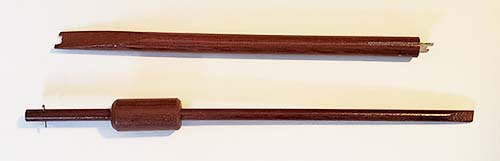
|
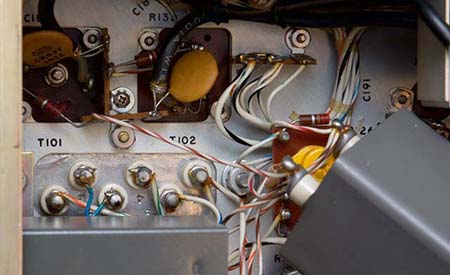
| Another Mod - I've run
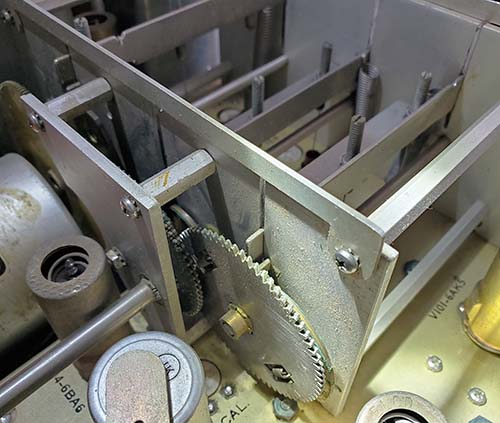
across this mod once in a while on early 51J receivers, like the J-1 and
J-2. These first versions of the 51J receiver had a very narrow IF
bandwidth with the spec being around 4 to 5kc at -6db. This selectivity
was a deliberate design feature for a receiver that was intended for
communication and primarily for RTTY, CW or other data-types of
transmissions. The 51J-1 and 51J-2 weren't intended for aural pleasure
or for listening to wide audio frequency AM Broadcast transmissions
(even though all 51Js do tune the AM-BC band.) Almost all Voice
"communications audio" had the frequency response limited to 300hz to
3000hz because that favored typical voice characteristics with the best
intelligibility given that most propagation conditions severely hampered
Voice comms anyway. However, I've found a few early 51J receivers that have
used 2pf to 3pf capacitors connected across the primary to secondary on the IF
transformers (pin 1 to pin 4.) This increases the coupling and that
broadens the bandwidth. The later R-388 receivers and all 51J-4
receivers had 2pf to 3pf capacitors installed to increase the bandwidth
to around 6kc at -6db. The J-4 has mechanical filters for determining
selectivity and the increase in the R-388 bandwidth was probably at the
request of the Signal Corps (since the caps first appear in the R-388.)
At any rate, the 51J-1 and the 51J-2 properly shouldn't have coupling
capacitors installed. Yes, the IF bandwidth is pretty narrow but that
produces the characteristic "sound" of these early 51J receivers. This
is about nostalgia and wanting to experience what the original operators
heard when using these receivers,...isn't it? One More Note on the Fallibility of Mods - Bill Orr's Feb 1978 Ham Radio article does have one suggestion that seems like a very easy check and repair if necessary. It involves the RF stage grid bias voltage affecting sensitivity above 15mc. According to Orr, he had checked several R-388/51J receivers and found that many had very high negative bias voltage on the RF stage grid. Orr thought the problem was caused by resistor value of the 820 ohm R149 resistor drifting to a higher value thus increasing the negative bias. Orr suggested that R149 should be changed to 680 ohms for the desired bias voltage -1.4vdc. All very logical,...but should the bias voltage be -1.4vdc? It's the spec out of the tube manual, so it must be correct. Much later, Dallas Lankford (Hollow State Newsletter) tried this mod and found the RF stage gain was increased but the dynamic range of the receiver was greatly reduced with the bias at -1.4vdc (the ratio of noise to signal levels.) His further research indicated to him that the -1.4vdc bias was probably a misprint in the Collins manual that was never corrected and that Collins had actually been using -1.8vdc as the target value. A lot of this was conjecture on Lankford's part and also any improvement could possibly be rather subjective. I have a hard time believing that Bill Orr wouldn't have noticed the change in dynamic range. It's an easy mod to try for a test so you can form your own opinion. As far as a lack of sensitivity,...good tubes, a good alignment and, most importantly, a good antenna will do wonders for the receiver when tuning above 15mc. Also, hearing fabulous DX on 15M or 10M during the summer months is not likely to happen no matter what you do to the receiver or antenna (well,...unless there's a contest going on.) |
| Lubrication - Unlike the R-390A receivers, with their roller bearings on all of the slug lifter racks, the 51J receivers just use a "rolled-end" on the slug lifter racks to act as a bearing against the brass cams. Where the roller bearings in the R-390A require lubrication with light-weight machine oil, the 51J receivers slug lifter rack ends require a light coating of grease. Any type of "sticky" grease will provide a good reduction in friction and reduce wear to the cams and slug lifter rack ends. Wheel bearing grease is probably a good choice since it's designed for high temperature and for staying inside the bearing. It doesn't take a lot of grease, just a light coat is all that's necessary. DO NOT use Lubriplate. It hardens quickly to become like cement. Carefully apply wheel bearing grease with a very small paint brush so the grease is only placed where needed. Other bearings are Oilite-type shaft bearings that don't really require any lubrication but if you feel it's necessary then only use one drop of machine oil for lubrication. Don't "over-lubricate." |
|
|
Necessary
Alignment Tools
- Most of the time these two Garolite tools are missing from the
R-388 and the 51J-4 receivers, which is unfortunate. They work really
well, especially the tool for adjusting the ceramic trimmer capacitors.
The tool for aligning the IF transformers also is very helpful. At one
time, these tools were being reproduced very accurately and were easily
available. However, a recent search (2023) on the Internet didn't find
anyone selling these reproductions anymore. They may show up on eBay
sometimes but I've haven't really seen that happen either. If you find a
set, buy them. Or, check with W3HM Radio Labs, Howard Mills might be a source for
these repros. W3HM e-mail info is in References at the end of Part 3 of
this web-article. Also, in advance of any alignments, build the series RC shunt for the IF transformers. Use 5" flexible wire leads with small alligator clips on the ends. Since one side is always connected to chassis, only one lead has to be moved. It really eases the IF load set-up. Also, have a series RC load for the antenna built consisting of a 47 ohm carbon resistor and a 100pf capacitor. It connects in series with the RF signal generator output to the receiver antenna input. |
| Rubber Feet for Collins A-line Cabinets
(like those shown in the photo)
- If your Collins cabinet has really worn or missing feet that
are the type shown in the photo to the right don't
replace them with the typical "hole-mounted" rubber feet. The
correct rubber feet are actually called rubber bumpers. The originals
were 1" in diameter and 0.5" tall with about a 1" long 1/4" x 20
threaded stud secured with an external tooth washer and 1/4" x
20 nut. McMaster-Carr carries rubber bumpers listed as "Threaded
Stud Bumpers" but their 1/4" x 20 studs are too short. However,
the mounting hole in the Collins cabinets is 5/16" diameter and
McMaster-Carr does carry a 1" x .5" rubber bumper with a 5/16" x
18 stud 1" long that will work fine.
The rubber bumper type of feet are found mostly on the 32V transmitter cabinets mainly because of the weight of the transmitter (~90 lbs out of the cabinet.) Some of the receiver cabinets might have hole-mounted rubber feet with aluminum spacers. These cabinets don't have the welded riser mount for the rubber bumpers that the 32V cabinets had, so the separate aluminum spacer had to be used. Since the receiver weight was normally about 35 pounds, the hole-mounted feet worked fine. |
|
| Reducing "High Line" AC using a Line Bucking Transformer - The 51J Series of receivers were designed to run on 115vac input voltage. Tube heater voltages and the non-regulated B+ voltage is dependent on 115vac being the line voltage used. Today, line voltages are nearly always minimum 120vac and often run up to nearly 125vac. Short term operation, such as testing or alignment, isn't usually affected by "high line" operation. Long term operation however will affect tube life and the higher non-regulated B+ can cause an increase in overall heat generated. It's very easy to add an external Line Bucking Transformer to lower the "high line" down closer to the specified input AC voltage. Using a 6.3vac filament transformer (that was designed for 115vac primary voltage) will lower the AC line by about 7vac to 8vac, e.g., lower a 124vac line down to 116-117vac. Our AC line here in Dayton is close to 124vac (123.8vac measured 7/29/22) and Line Bucking with a 6.3vac filament transformer lowers the AC line to 116vac. For receivers I use 6.3vac rated at about 3A minimum transformers and for medium power transmitters I use 6.3vac at about 8A minimum. It's not critical since the VA is only for the small voltage drop, not the entire VA the equipment requires. You can always use a larger current-rated filament transformer, especially if you want to use it to supply 115vac to a power strip, just be sure to have a primary switch on the bucking transformer. There are lots of easy hook-ups shown on the Internet (search on "line bucking transformer.") Of course, an autotransformer (Variac or Powerstat) could be used just as easily but filament transformers are plentiful and cheap. Variacs are also plentiful, just usually not cheap. Besides, the Variac belongs on the test bench. |
|
Easy Access to the Crystal Filter - How many times have you wanted to get into the Crystal Filter assembly on the 51J receiver but were intimidated by its lack of obvious and easily removable covers? Well, Jan Wrangel SM5MRQ, decided to get into his 51J-4 crystal filter and took photos to document just how easy it is to gain access to the Crystal Filter components. If the receiver is in a cabinet it has to be extracted out of the cabinet. Then remove the top cover and the bottom cover. From the top of the Crystal Filter assembly a single screw has to be removed. From the bottom, the choke nearest the front of the chassis has to be dismounted (just unbolt the choke - no need to unsolder the wires) to allow access to a 6-32 nut that is underneath the choke (between silk-screened IDs T101 and T102.) This nut mounts the bottom of the Crystal Filter top plate. Once the nut is removed now the top cover of the Crystal Filter can be removed from the top. This allows access to most of the circuitry inside. Reassemble in reverse order when checking, repairs or cleaning have been completed. If further access is required such as removal of the IF transformers inside, then more disassembly will be required. Complete extraction of the Crystal Filter assembly will require some unsoldering work. This procedure is only for simple checking, cleaning and minor repair work to the Crystal Filter. Thanks Jan!
NOTE: Crystal Filter Alignment - It can be seen from these photos that T101 and T102 have what appears to be a slug adjustment on top and a threaded rod adjustment on the bottom. Each of these IF transformers have only one slug and one adjustment. The top adjustment it easiest to access and is usually the one that's used. The slug also has a brass threaded rod that exits out the bottom and can be accessed from under the chassis, if required. Although it looks like there are two adjustments on both T101 and T102, there's just one slug per transformer that has two methods of adjusting the position of that one slug. T101 is adjusted for peak at 500kc and T102 can be adjusted using a sweep generator to present the IF bandwidth as an oscilloscope pattern. Then T102 is adjusted for the most symmetrical response as the Phasing control is adjusted in position 2. In the USN manual for the URR-23A, an alternate procedure is shown (and it's not in any of the other 51J manuals) that is for adjusting T102 without a sweep generator or 'scope. This procedure has the operator offset the signal generator frequency by 3kc when in position 2 and adjust T102 for the most symmetrical -DCV output on the diode load when the signal generator is alternately adjusted to 497kc and to 503kc or +/- the 3kc. The USN manual does indicate that this is an approximate adjustment of the Crystal Filter. |
|
|
|
|
| Alignment Holes for Cam
Points for RF-Mixer Cams - If you've ever had the
need to check the cam point alignment on the RF-Mixer slug racks and you've read the
manual to find what frequency to set your 51J receiver to for cam
alignment, then you've discovered that Collins never indicates a
frequency. The implication is that if one cam point is showing in
one hole, then the other two holes will also show their cam points.
Or, you can do multi-step procedure that measures how far the cam
riser is for certain cams at certain frequencies and for each of the
three cams. There has to be a better way. Thanks to Oskar SP5LKO, who searched through Hollow State Newsletters and found that Dallas Lankford also researched this problem. Lankford found the 8.300mc is the frequency to set the 51J receiver to and that will have all three cam points showing through their alignment holes. Note in the photo shown to the right, the cam point alignment holes are only on the front plate of the rack assembly. Also, the three holes are very small, probably about 0.125" diameter. In the photo, the highest frequency cam (16mc-30mc) is pointing to the hole at the lower-right corner of the front plate. The second hole isn't visible in this photo. The third hole can be seen in the background and it can be seen that the lowest frequency cam point (4mc-7mc) is aligned with its hole. The receiver is a R-388 and it's set to 8.300mc. These little holes are not very obvious and, from the front of the rack assembly plate, they are difficult to see. Also, the cam points are difficult to see. Requires a flashlight. Perhaps the intent was to use a piece of 12-14 gauge wire bent at a right angle and then insert the bent end into the hole to act as a "feeler gauge." In actuality, this is just a quick check to see if the slug rack is set up correctly. Thanks Oskar! |
|
| R-388 and 51J-4 Repro Megacycle Dial Drum Overlay - Some of the megacycle dial drums that still have their original band scale overlay appear quite different nowadays than they did when they were new. Many of the original overlays have darkened considerably with their present color ranging from medium yellow to dark amber. The color change is certainly expected and acceptable, if the dial overlay is in otherwise excellent condition. But, many drums will have nicks, gouges, stains, scratches, bubbling and flaking that can range from very minor and perhaps acceptable wear up to a completely destroyed original overlay. Luckily, the new reproduction overlays are very nicely made with real printing, in other words,...not a copy machine creation. The original color was kind of a cream color, that when illuminated with real #47 incandescent lamps, looked a light yellowish-cream color. The new overlay comes with a self-adhesive back to ease installation. The surface of the old drum must be sanded with 400 grit paper to provide a clean and level surface for the the adhesive to adhere to. Prep is all-important. Also, important is to not sand the original drum overlay completely away. Enough has to remain to see where to install the new overlay. Also, a pencil centerline should be lightly marked on the edges of the new overlay from a mid-scale point and also on the drum at the same point to provide accurate alignment for installation. The pencil lines can be erased after installation is complete. Start with clean dry hands (or wear thin cotton gloves.) Start mid-center and work evenly in each direction being careful to avoid air bubbles. Go slowly and carefully because once the self-adhesive glue is in contact with the drum, the overlay can't be removed. As the installation proceeds, a soft paper towel can be used to lightly smooth out the overlay as it's installed. Once the overlay is completely applied and there aren't any air bubbles, the soft paper towel can be used to rub with slightly more pressure for good adhesion. Then the new overlay can be given a few sprayed-on coats of Krylon Clear Lacquer to protect it and, more importantly, to impart the slight sheen that the original overlays had. These repro overlays are necessary to restore a "rough-condition" original dial drum. They shouldn't be used on good condition drums just because of the age-related color change. | Original vs Restoration - Data Plates - Some restorations are so good, it's difficult to tell what's original and what has been replaced with good condition parts for another receiver. In most cases, especially when considering components that were always replaceable like tubes, circuit components or some assemblies, it's not important. But, then there are the items that indicate manufacturing date or contract or original end-user. These are the data plates that are so important but many times are missing and other times not seeming to fit the time-line of the particular receiver. Some restorers will install a proper data plate obtained from another receiver and this seems to be no problem in the short-term. But, when the data plate information is later used to try to date some of the manufacturing details, nothing seems to fit with the data plate information. My suggestion (and this is what I do) is to write on the back of the data plate that it's a replacement from a "parts set" receiver and not the original data plate for the receiver that it's installed on. Of course, it does depend on the curiosity of the researcher that they might be interested enough to remove the data plate for examination. Of course, on most R-388 receivers, this happens fairly often to check on what's stamped on the panel under the data plate. Nowadays, with decades of date plate swapping, starting with the Army depots and more recently with careless restorations, many questions arise when the data plate appears original but doesn't match some of the key manufacturing points. Just write "Replacement - Not Original" on the back of a replacement data plate. It might help someone in the future. |
| CONTINUE to Part 3 GO to Part 4 GO to Part 1 Return to Home Index
|
Radio Boulevard
Western Historic Radio Museum
Vintage Radio Communication Equipment Rebuilding & Restoration Articles,
Vintage Radio History and WHRM Radio Photo Galleries
1909 - 1969
- 60 years of Radio Technology -
This website created and maintained by: Henry Rogers - Radio Boulevard, Western Historic Radio Museum © 1997/2026