|
Western Historic Radio Museum
DM-28 Dynamotor into Modified BC-348 - or - Returning Your BC-348 to its
Complete, Original by: Henry Rogers WA7YBS/WHRM
|
![]() |
| Let's face it! Almost every, single BC-348 has fallen victim to the "cut and hack" mania that afflicted many hams back in the fifties and sixties. If you're lucky, the BC-348 you happen to find might only have an AC power supply installed. However, even this simple modification required a lot of changes to the BC-348 circuit and today, if you want to return the BC-348 back to its original configuration, you can't just drop in the DM-28 dynamotor and expect the receiver to function. This article will detail not only what is required to retrofit the DM-28 into a modified BC-348 but also details other aspects to consider in the restoration of these great receivers. This article is specifically for the BC-348-Q. The "Q" version was the most popular of the BC-348 series with probably well over 40,000 receivers having been built by Wells-Gardner. Of note is that the "Q" version is virtually identical to the "N" and the "J" versions. These three versions use single-ended tubes (no grid capped tubes) and feature a much better performing circuit that is a lot easier to work on. |
|
A Brief History of the BC-348 Series Radio Receivers |
|
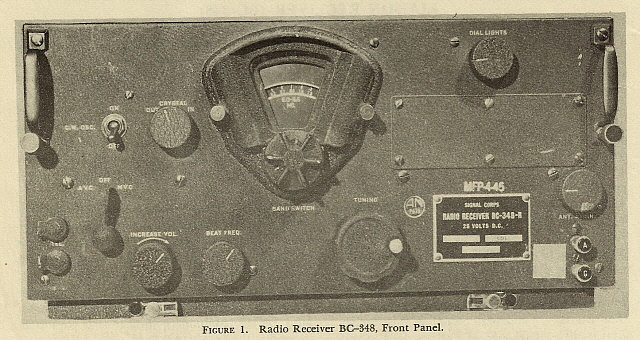
The BC-348 Aircraft Receiver was designed by RCA in the late thirties. It operates on 24-28vdc with the high voltage (~+220vdc) provided by an internal dynamotor. Many tens of thousands were built during WWII by many different contractors building many different versions within that time period. The circuit used eight tubes with the heaters originally wired in series-parallel for 24vdc operation (two parallel strings of four 6 volt tube heaters in series would operate on 24vdc.) The "early" circuit provided two RF amplifiers, a Mixer, a Local Oscillator, an IF amplifier stage, a combination 2nd IF amp and BFO, a combination 3rd IF amp and Detector/AVC followed by a type 41 audio output stage (this was changed to a 6K6 in some versions.) Some versions also will have a 991 neon lamp acting as a regulator on the local oscillator and some versions provide an antenna trim control. The "later" circuit used two RF amplifiers, a converter stage, three IF amplifiers, a duplex diode/triode provided Detector, AVC and BFO functions and a 6K6 provided the audio output. The audio output impedance was internally selectable at "low Z" which was around 300 Z ohms or "high Z" which was around 4000 Z ohms on later versions. Some BC-348s will have a decal on the front panel indicating if the "low Z" was optioned. A selectable crystal filter was also included in the circuit. The dual dial lamps were adjustable for brightness and were wired in series through a potentiometer and fixed resistor. Frequency coverage was from 200-500kc (not on the B or C version) and 1.5-18mc. When the receiver was installed on its FT-154 shock mount and installed in the aircraft, an eight pin Jones plug mated with a receptacle and cable that exited from the rear of the mount containing the 28vdc input, the remote stand-by relay function and an audio output line. The BC-348 was generally interconnected with the transmitter (usually a BC-375) to control boxes allowing the transmitter's control relay to provide antenna switching, receiver stand-by and providing side tone monitoring which allowed for full "break-in" keying. Since there are so many variations, military collectors have generally divided the BC-348 into two groups, "early" types (B, C, H, K, L, O, P & R) with grid cap type tubes and the "later" versions (J, N & Q) with single-ended tubes. Several of the earlier versions were rebuilt into later configurations, especially to add the 200-500kc band. The conversion of the " B" or "C" into an "R" is typical of the process. Many different contractors built BC-348s but Wells-Gardner Co. probably built the greatest quantity of receivers and is the most commonly seen manufacturer. The BC-348 became available as surplus in the 1950s allowing hams the ability to purchase a great performing receiver at a reasonable price - NOS and still in the crate for about $75. The down side is that today it is almost impossible to find a BC-348 that hasn't been modified. Typically, the dynamotor will have been removed and an AC power supply added. This mod was fairly simple and usually didn't compromise the receiver's performance (other than adding some hum to the audio output if the power supply wasn't well-filtered.) Many other dubious modifications were published in various surplus conversion books of the day that actually did compromise the BC-348's performance. Additionally, many hams would drill the case with lots of .25" holes thinking the receiver needed extra cooling. Originally, the BC-348 operated at altitudes up to 25,000 feet where the temperature inside the aircraft was below zero - cooling the receiver was not a problem. But even on the ground in other applications, the BC-348 didn't run hot and adding ventilation holes only ruined the cabinet. Other variations include, the BC-224, which was a 12vdc version used for earlier aircraft electrical systems. Its external appearance is identical to the BC-348. Today, with the increasing popularity of hams running completely military radio stations, the BC-348 is often being used as the station receiver. Sometimes this is because the original military configuration requires its use, other times because the operator knows that it's such a great performing receiver. Fabulous military looks, excellent sensitivity and good selectivity (when the IF is properly aligned) have made the BC-348 a favorite among the military radio enthusiasts, knowledgeable hams and collectors of WWII airborne radio equipment. |
|
Finding a Good Candidate for Restoration |
| What to Look For - After you've looked at a lot of
BC-348 receivers, it becomes pretty easy to eliminate the "victims" from
the "survivors." "Victims" will have extra controls, perhaps a "hacked
in" S-meter, generally sloppy workmanship and sometimes lots of extra
holes drilled in the cabinet. Of course, I'm exaggerating a little bit,
but the ideal "survivor" BC-348 will have all the original controls and
no extra ones. Everything will appear correct on the exterior. Pull the
receiver out of the case and check the chassis for obviously missing
components - it is common to find the combination audio output
transformer-filter choke missing. It's also possible that an extra stage
of audio amplification might have been added. What you want to see is
all of the original components present with the exception of an AC power
supply that just fits into the area where the dynamotor originally was
and is mounted to the chassis using the original dynamotor threaded
bosses. This is about as close as you can normally come to finding a
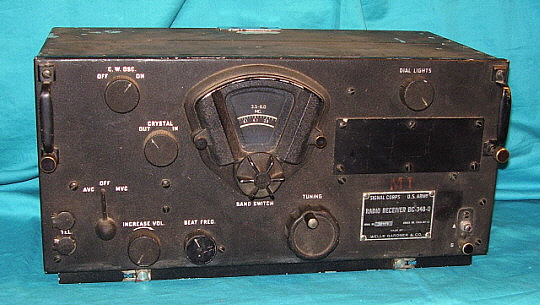
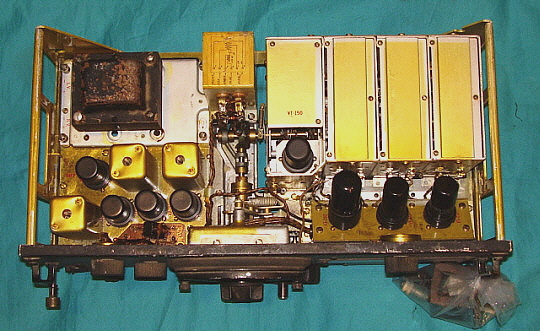
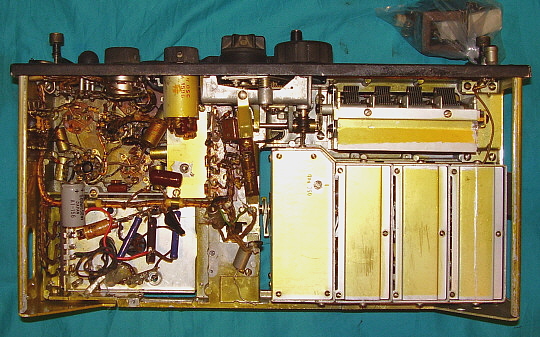
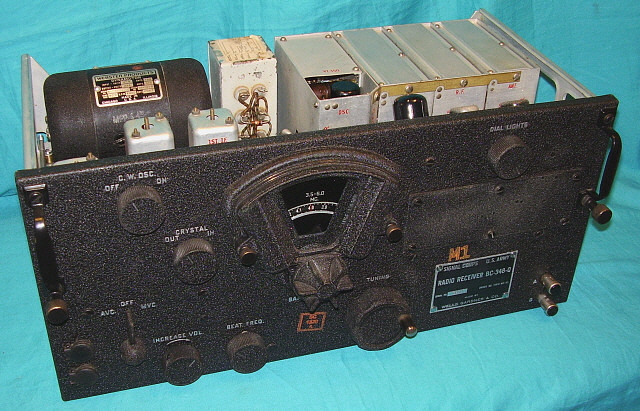
"perfect" BC-348 - at a reasonable price, anyway. The photo to the right shows a typical "looks good" candidate. No extra controls, no extra holes. Everything looks pretty good on the exterior with the possible exception of the RCA phone jack for the Antenna input. The photos below show what surprises are lurking inside this particular BC-348. photo right: BC-348-Q sn 20966 looks like a good restoration candidate. |
![]() |
![]() |
|
| Once the receiver is pulled out of the case it becomes apparent that
BC-348-Q sn 20966 was modified by someone lacking the technical ability
and experience to do a competent job. Note that the top of the chassis
looks complete and original except for the AC power supply that was
built onto the old dynamotor chassis but underneath extensive
modifications have removed many of the original parts. Of note, the
complete Jones-type plug assembly is missing along with C-70A/B*, the
dual filter capacitor. Fortunately, the modifier utilized the existing
wiring harness and terminal connections to the AC PS. This particular
BC-348 is certainly a very good candidate for complete
restoration. Actually, it's in much better condition than most BC-348
receivers you find. But, as with most examples that turn up today, I'll
be collecting parts for this restoration for awhile. In fact, the
plastic bag tied to the front handle contains some of the replacement
parts I've already located. When you find a BC-348 restoration candidate, you'll want to know "up front" how much work and how many parts you are going to have to find in order to complete the restoration since this is going to affect the final selling price. It is imperative that the prospective BC-348 chassis be inspected thoroughly. If the receiver is being purchased online, be sure to insist on complete photos of the top and bottom of the chassis so you are aware of any missing parts or other problems ahead of purchasing the receiver. * I'm just adding a letter prefix to the original numerical designation to help in recognizing the type of component. |
| What to Look For in Your Preliminary Detailed Inspection
- What you should find upon closer inspection of the modified circuit is
that the original series-parallel wiring of the tube heaters has been
changed to all of the tube heaters connected in parallel. This allowed
the tube heater string to operate on 6.3vac rather than the original
+24vdc. This was the most common AC power supply configuration. You will
find that three resistors have probably been removed R-82, R-84 and
R-85. These resistors limit the surge current on start-up when operating
the (cold) heater string on +24 to +28vdc. You should also find that the
two dial lamps will have been wired in parallel for 6.3vac operation.
Additionally, with the dial lamps there is a series resistor (R-81) and
a potentiometer control (R-111) - "DIAL LIGHTS" - that sometimes have
been removed and a switch substituted for potentiometer and resistor.
It's common to find C-70A/B, the dual filter capacitor, missing. It's a
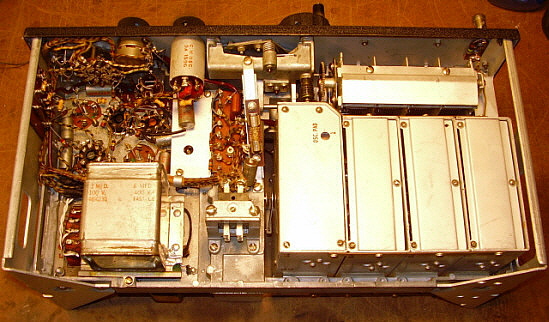
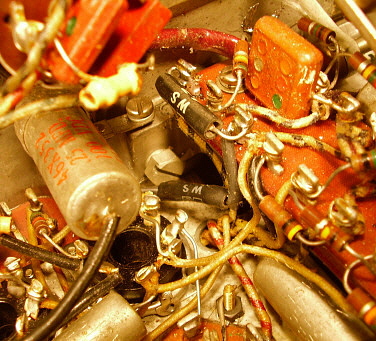
large square metal box mounted under the chassis. How little damage is found in how the AC power supply has been fitted into the receiver will depend upon the technical abilities and experience of the original modifier. Most of the time the wiring harness isn't too badly damaged and it will only require a little dressing up, re-routing back to original and re-installation of the spade lugs in order to have the proper connections to the dynamotor terminals. Sometimes you may have to re-install some wiring in order to have the harness wires at the proper place for connection to the dynamotor terminals. photo right: The underneath of a nicely modified BC-348-Q where the AC PS installation has done minimal damage (Sn 11227) |
![]() |
|
The normally found AC power supply modification has some way provided for the AC power cord to exit the receiver. This usually involves removal of the 8 pin Jones-type male plug SO-143 that was how the 24vdc was originally routed into the receiver along with remote stand-by and audio outputs. If SO-143 is missing an original will have to be found. Additionally, the remote stand-by and audio output functions will normally be disconnected. You will usually find the remote stand-by wired to be permanently in "receive." Originally, the BC-348 was powered up with the AVC-OFF-MVC switch. Normally this is also used by modifiers as the AC power switch. Hopefully, a non-original ON-OFF toggle switch wasn't installed into the front panel. Why this was done on so many BC-348 receivers is a mystery. I think many modifiers thought the rotary switch wouldn't handle switching the AC. I've only encountered one BC-348 that had the rotary switch damaged and that was probably because of a wiring problem in the modification. Normally, the rotary switch handles the AC current fine. When everything is returned to original, the 24vdc will be applied by using the AVC-OFF-MVC switch. Fortunately, most modifiers seem to mount the AC power supply chassis to the original dynamotor threaded bosses. This does no damage to the chassis. Occasionally, an ambitious modifier will "cut and hack" a power supply into the chassis - both top and bottom - but this is rare. This should be all of the modifications that will be found in a BC-348 J, N or Q series that has only the AC power supply installation. |
|
Locating Missing Parts |
| Parts Sets - Since the BC-348 is a very common
receiver with thousands available it becomes practical and even
desirable to purchase at least one "parts set." Sometimes one receiver
has to be purchased for great external cosmetics and another because the
chassis is perfect. It is very common to have to use at least two and
often three different BC-348 receivers to build-up one complete,
operational and original receiver. It is often much faster to purchase a
"parts set" rather than to spend an eternity looking for a specific part
that never turns up separated from a receiver. Unfortunately, even the
BC-348 receivers that are in a condition that relegates them to "parts
set" status, are nowadays fairly expensive. However, the time that is
saved must be part of the equation in figuring how much to spend on a
restoration. Advertising - Sometimes this works but usually it is time consuming with very little success. I've had moderate success with QTH.com but other advertising avenues seem to not be worth the time involved. E-Bay - E-Bay works quite well for locating parts. Be prepared to pay absolutely the highest price for any part that happens to turn up for auction. In comparison to time involved in finding parts versus paying e-Bay prices, it's probably worth the higher prices since the items can be located and purchased fairly fast. Who wants their restoration to drag on and on? |
|
Commonly Missing Parts |
| The following resistors will more than likely be missing: Part
Number 82 - Resistor - 190 ohms 2W CC - parallel with RF Amplifier
tubes heater string and the Converter tube heater |
| The following parts are often missing from modified BC-348 receivers... |
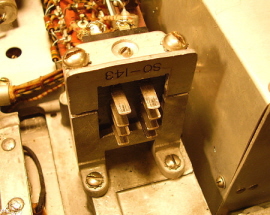
Jones-type male plug, 8 pin, SO-143 - This assembly is made up of several parts that include the contact pins, the bakelite insulators, the two-piece aluminum housing, a bakelite block centering screw and four mounting screws and lock washers. Some parts lists identify this connector as SO-103. The original connections to the plug were +24vdc, -24vdc, AF output (worked against chassis) and Remote Standby. The -24vdc was connected directly to chassis adjacent to SO-143. In the original configuration, the FT-154 shock mount was wired into the aircraft system via P-103 which was mounted to FT-154 and mated with SO-143. When the BC-348 was installed onto the shock mount, then SO-143 engaged P-103 and the receiver was then connected into the aircraft power and control system. IMPORTANT NOTE: When doing any work on the SO-143 connector where disassembly is required, be sure to carefully examine how it is assembled. You must make notes for correct reassembly! This connector can be assembled several different ways, with different pin lengths, different heights and none of them will fit into the PL-103 receptacle on the shock mount. Only one way of assembly is correct. So, be sure to carefully observe how the unit comes apart, so it goes back together the right way. Be sure to test your BC-348 mounted SO-143 connector for proper fit into the FT-154 mounted PL-103 receptacle before initial disassembly. |
|
|
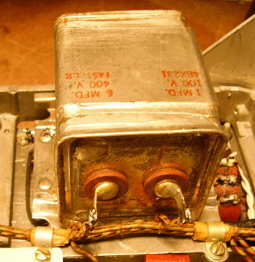
Dual Filter Capacitor, Part Number 70 (C-70A/B) - This is a dual filter capacitor with a 6uf capacitor on the B+ line and a 1uf capacitor as a cathode bypass for the 1st AF amplifier tube. This is a large square metal can that is mounted under the chassis and somewhat under the dynamotor bottom cover. Probably because of the proximity to the modification AC power supply, this capacitor is many times removed. Modifiers probably felt that the filtering in their AC power supply was sufficient and just added a replacement capacitor for the cathode bypass unit. It is original to have this unit installed, so if it's missing, an original will have to be found. Be sure to test the replacement C-70A/B. These were high quality units that rarely are bad. If you are uncomfortable using 60 year old components, then you can rebuild C-70A/B by installing new capacitors inside the can. The bottom can be removed by cutting along the bottom seam. Then the capacitors can be removed, new components installed and the bottom re-attached. I usually just test and install an original unit. Most of the capacitors installed in the BC-348 are high quality metal cased units that rarely fail. I usually only replace defective ones (rare) and then I try to utilize tested-good original components from a parts set. If you feel like all of the capacitors need to be replaced with new components, then you can replace with SBE orange drops if the under chassis appearance is not a concern or the originals can be rebuilt (restuffed) although this is a difficult process. |
|
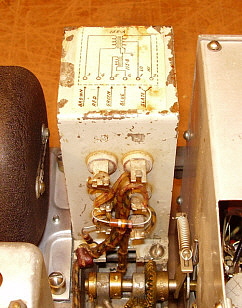
Audio Output Transformer & Filter Choke, Part Number 115A/B (T-115A/B) - This is the combination audio output transformer and filter choke. It is unique to the BC-348 series. If it is missing an original will have to be found. The audio output transformer on the J, N and Q versions will have two terminals to select either 300 ohms Z (low Z) or 4000 ohms Z (high Z) for the audio output impedance. The two top terminals shown in the photo to the right are marked LO (on left) and HI. Moving the wire from one terminal to the other accomplishes the change in output Z. Some receivers will have a decal on the front panel the shows that "LOW Z" has been wired for the output Z. What Z you select depends on what you intend to operate as your audio reproducer. The LS-3 is popular but its original Z is 8000 ohms. The LS-3 was never originally used with the BC-348. Hi-Z headsets will require the 4000 ohms Hi-Z and the 300 ohms Lo-Z works fine into a 600 ohm Z load - lo-Z 'phones or 600 ohm matching transformer. Why some modifications removed T-115A/B and then added an extra stage of audio amplification is probably due to the belief that insufficient audio was present for loud speaker operation. This is a myth. The J, N and Q versions produce ample volume to drive a properly matched loud speaker. You can run an original 8K ohm Z LS-3 with the Hi-Z tap selected and the volume will be very loud. If you have modified an LS-3 to have a 600 ohm Z input, it will have plenty of volume using the Lo-Z tap. One has to remember, the original intent was to use earphones, but the LS-3 speaker does work fine with the BC-348 using the original T-115A/B. It's possible that some of the old modifications sought to match the receiver to 8 or 4 ohm Z loud speakers and that is why they went on to add an extra AF output stage with a standard AF output transformer. Totally unnecessary, of course, but that was the "modification craze" - do whatever you can to "undo" what the real radio engineers had designed. |
|
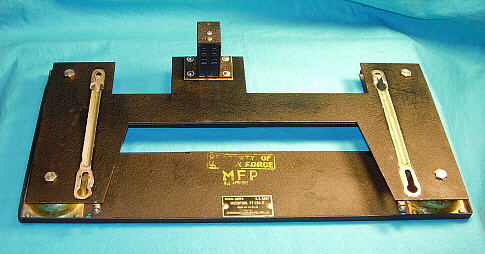
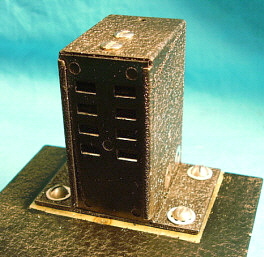
| The Elusive FT-154 Shock Mount - The
FT-154 shock mount is almost never found with a BC-348 receiver. The
shock mounts were probably left on the aircraft when the receivers were
pulled which accounts for why the FT-154 is almost always found
separated from the receiver. Although you can certainly operate the
BC-348 without the shock mount, the FT-154 does provide a proper way to
support the receiver - on cushioned mounts - and safe way to apply power
to the receiver - via the rear connector (if you also have PL-103.)
Also, the FT-154 does somewhat change the total overall appearance of
the BC-348 in a positive way. I have encountered two different BC-348 receiver cases that have had the bottom plate that has the pointed engagement pins removed. This was done by drilling out the pop-rivets and removing the entire bottom plate. This leaves the case with out anything between its bottom and the table it's setting on. Both cases had glued-on rubber feet on the bottom of the case. Of course, this totally ruins the receiver case for future mounting on the correct FT-154. Fortunately, a BC-348 case is not too difficult to find. Don't worry that the inside paper tag might not match your version receiver. Most receivers were indiscriminately mounted in any case handy while in the repair depot so today most BC-348 receivers are not in matching cases. The current prices for the shock mount reflects its rarity. An FT-154 will usually sell for $150 to $200+ depending on where you find it. |
|
| PL-103 - This receptacle is mounted to
back of the FT-154 Shock Mount and is what the SO-143 plugs into when
the receiver is mounted to FT-154. There are two versions that were
made, the PL-P-103, which is straight back exit type and the PL-Q-103,
which is a right-angle exit. The +/-28vdc input, the audio output and
the remote standby line are all connected to the BC-348 via PL-103. The
photo to the right shows a close up of the PL-P-103. As can be seen, this
connector assembly has several parts to it. You can also reference the
photo of the FT-154 shock mount to see where and how the PL-103 mounts.
The cables exit out the back of the connector and then are routed down
through a metal tube that either points directly to the rear or points
to the side. The wrinkle finish metal cover goes over the entire
connector and only the metal tube can be seen exiting from under the
shock mount. There are some vertical exit plugs for the BC-348, the PL-P-103 (same identification as the straight back exit which is confusing,) and these plugs do work fine. It's tight clearance from the bottom of the outlet tube to the table surface but you'll have about a half an inch which is plenty of room for the cable. Originally, these plugs were used when the BC-348 receiver was going to be mounted in a manner other than directly on a table top or the table had a hole for routing the cables underneath. At present these are the only easily available PL-103 and they show up regularly on eBay or can sometimes be purchased from Fair Radio Sales. If You Can't Find a PL-103 - The correct PL-103 receptacle is very difficult to find and usually very expensive. While you are searching for this part, you'll probably want to run your BC-348. Buy a packet of "Push-On Connectors - Female .187" x .032" - these crimp onto the wire ends and then will push onto the flat finger contacts of the SO-143 plug on the BC-348. They are a fairly "tight fit" and won't pull off easily. You can make up a harness that has 14 ga. wires for the 28vdc input (LV+ and LV-) and 20 ga. wires for the Standby Relay function and the Audio Output (if you want to use this output rather than the phone jacks on the front of the receiver.) This set-up will look totally original unless you look at the rear of the receiver and the Push-On Connectors work great. When a PL-103 receptacle is found, you can use the same harness by removing the Push-On Connectors and then soldering the harness wires to the proper pins of the PL-103. |
|
|
DM-28 Details |
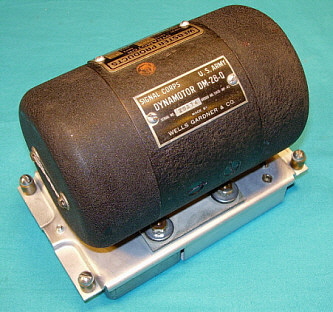
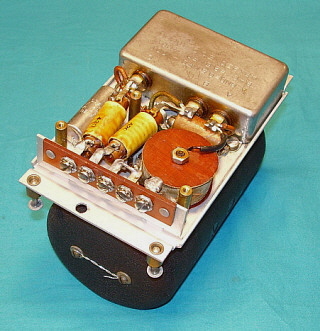
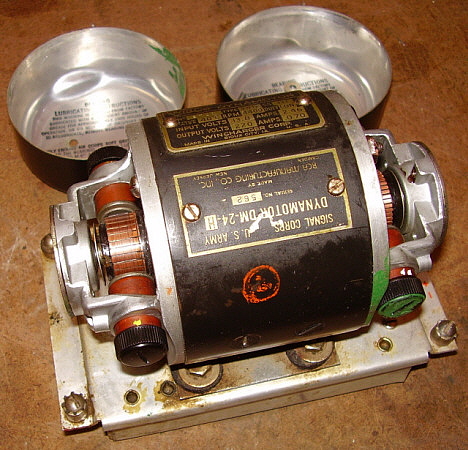
| Finding the DM-28 and What to Look For -
The correct dynamotor for the BC-348 is the DM-28 which operates on
24vdc to 28vdc input, originally supplied by the aircraft
battery-charger system. The dynamotor provides an average of
220vdc output. It takes about 1.8A under full load to run the dynamotor.
But the initial start current, that is, the current required to actually
get the armature moving, is closer to 8A or 9A. This current is only
required for an instant and as soon as the armature begins to move the
current drops rapidly. The DM-28 assembly consists of the dynamotor, the
filter assembly, the terminal strip and the chassis. You'll need to find
the entire DM-28 assembly, as shown in the photo to the right.
DM-28 prices vary from source to source. E-Bay prices are normally around $125 for the complete assembly, although they sometimes go as high as $185. Swap meet prices will be about half, if you are lucky enough to find a DM-28 at a swap meet. Sometimes just the dynamotor turns up but, without all of the other parts, it will only be useful as a spare unit. Most restorers feel that the time saved in an eBay purchase makes up for the higher prices.
|
![]() |
![]() |
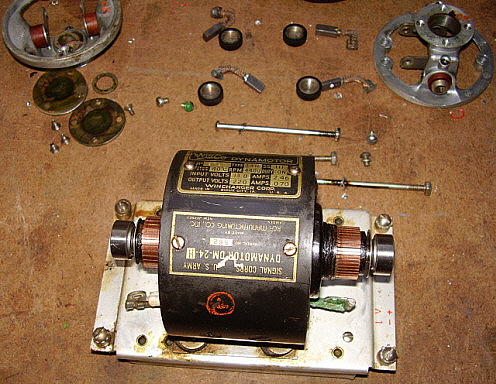
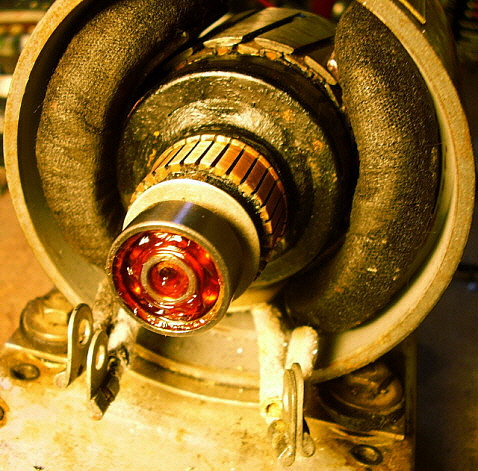
| Servicing the DM-28 - More than likely, your newly acquired DM-28 will not have had anyone checking the lubrication of the bearings in the last several decades, if ever. You are going to have to pull the end-caps of the dynamotor to check the bearings. Once the end-caps are off, you can also inspect the commutators. There will be darkening of copper where the brushes ride on the commutator but there should be very little wear. Remove the brushes but be very careful to observe and mark their orientation because you have to re-install them exactly the same way. Clean the commutators using 400 grit aluminum oxide paper. Wipe the bright copper segments with denatured alcohol to clean and clean between the segments with a stiff paint brush. Now, unscrew the bearing covers. You will probably see old, brownish-yellow grease that is not really in the ball bearings anymore. Clean the ball bearings with solvent to remove the old grease. Blow out with compressed air, if you have it available. Repack the ball bearings with new wheel bearing grease. The newer wheel bearing greases are usually red in color and good for very high temperatures. Rotate the armature as you work in the grease. When the bearing is full, install the bearing covers. | Check the condition of the rubber mounts - they should be elastic
and not all dried out and hard. If you find hardened motor mounts they
will have to be replaced otherwise the dynamotor will run noisily. Now
you can re-install the brushes. Apply 27vdc to LV+ and LV- terminals and
the dynamotor should start running very smoothly and very quietly.
Remove the voltage and replace the end-caps. The dynamotor is now ready
to install into the receiver. If you find excessive wear on the
commutators they will have to be turned on a lathe. This requires
removing the armature from the frame. Turn the armature on the centers
of the shaft to avoid having to remove the bearings. The bearings are a
hard press fit to the shaft and difficult to remove. The BC-348 manual
has more details on rebuilding the DM-28 if your's happens to be in
particularly poor condition. Normally, the dynamotors are in pretty good
shape and really only need to be serviced for them to then operate
smoothly and quietly. |
|
Other Useful Information |
| VT Designation to Standard Tube Identification for
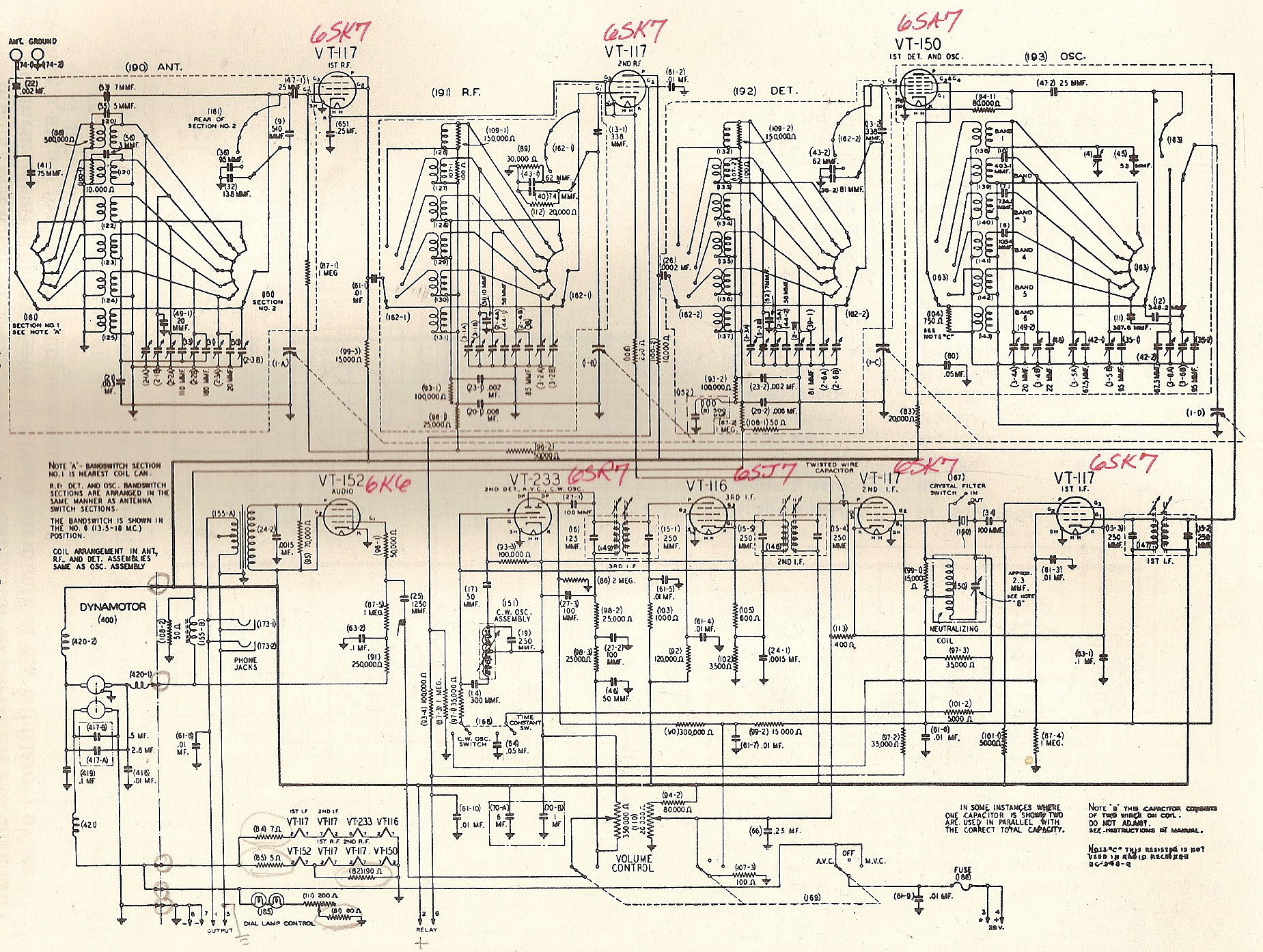
the BC-348 J, N and Q Versions VT-116 = 6SJ7
VT-150 = 6SA7
VT-233 = 6SR7 VT-117 = 6SK7 VT-152 = 6K6GT |
Schematics - These are available from several sources. I'm using the schematic that is in "Surplus Schematic Handbook" by Kenneth B. Grayson W2HDM, which was part of the CQ Technical Series, published by Cowan Publishing Corporation in 1960. My references to various components are from this schematic except that I have added a letter prefix to identify what kind of component it is. So, R-84 is listed on the schematic and parts list as 84. Manuals and schematics are available free from many online sources. BAMA has available the correct manual for the BC-348 J, N and Q versions. The schematic available on BAMA for the J, N and Q is actually for the earlier versions and is not usable for the J, N and Q versions. I'm including this link to my scan of the correct schematic for the BC-348 J, N and Q from the "Surplus Schematic Handbook." (1.7M) BC348Q Schematic |
|
Retrofitting the Parts and Testing the BC-348 |
| Before you Begin the Retrofit - If the modified BC-348 you've selected for the retrofit is in great condition and appears mostly complete, it's probably a good idea to get the receiver operational on its AC power supply. It probably did work at one time, especially if it looks like a nicely done job, so getting the receiver operational before the retrofit of the dynamotor will reduce the amount of work you have to do later. |
| How to Change the Tube Heaters Parallel Wiring
Back to Series Parallel - Look at the two drawings that are
shown below. One shows the typical Parallel hook-up that is found in
most AC modifications. The other shows the correct, original
Series-Parallel connections for the tube heater strings. Most of the
time, the conversion to Parallel only has a few jumps and a couple of
extra wires to remove. Once you know what to look for by looking at the
drawings below, it becomes fairly easy to remove the tube heater
modifications. You'll have to install R-84 and R-85 as shown in the
photo left. The terminal board (pin 3) is the +24vdc tube heaters
connection (sometimes pin 1 in some receivers - see note below with
drawing.) The resistor from pin 3 to pin 1 is R-85, 5 ohms 1W and
connects +24vdc to the tube heaters for the AF output, 1 & 2 RF amps and
the Converter tubes. Also connected to pin 3 is R-84, 7 ohms 1W that
also connects to pin 7 of the IF amplifier tube and then on through the
other IF amp tubes and the Det-AVC tube. There is a shield that mounts
over the IF amp tube socket so R-84 leads must be sleeved and mounted
close to the chassis with the one lead coming up vertically to the
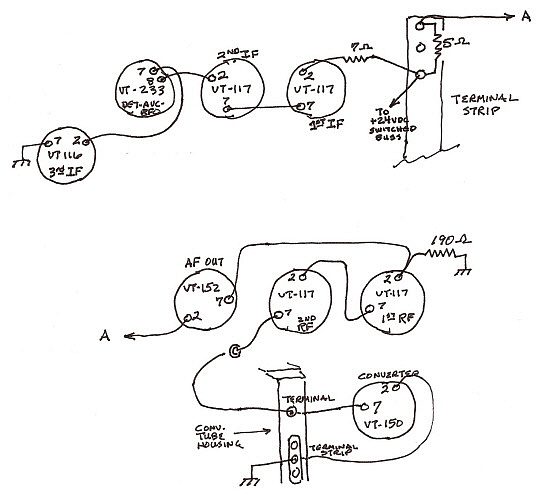
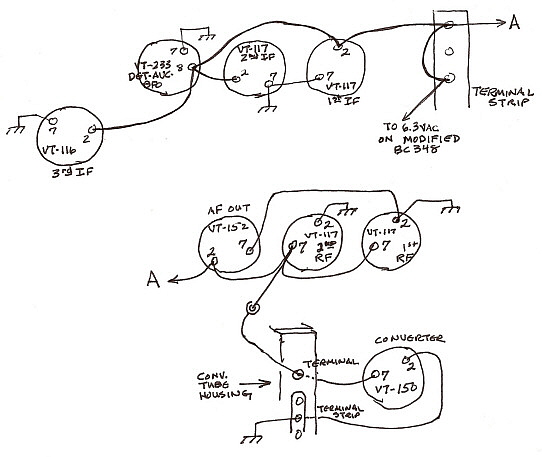
terminal board. This provides good clearance for the shield. Underneath the RF/AF chassis (remove the front panel access cover to access) you will have to remove the Parallel wiring modifications and return the wiring to Series-Parallel. You will also have to add R-82, 190 ohms 2W from pin 2 of the 1RF amp tube to ground. There is a ground lug on the tube socket mounting that was originally used to mount R-85. Note that the wire jump from the AF output tube socket to the Converter tube has to exit through a chassis eyelet and then connects to a terminal on the metal housing for the Converter tube. Usually no changes were done here since the return connection to chassis is from pin 7 of this tube. Reference the wiring diagram shown below for how the original series-parallel is accomplished. Also shown for reference is the typical modified parallel wiring diagram. Once the tube heater wiring is returned to original, "ohm out" the connections to verify it is correct. Then install the tubes and apply +24vdc to the tube heater terminal and verify the correct voltage on each tube heater, approximately 6vdc. You will probably see about 5.8vdc or so if you use +24.0vdc but remember that a fully charged battery set-up will provide about 27.5vdc. The design allows for wide variation from a low of 24vdc up to about 28vdc. |
|
|
Original +24vdc Series-Parallel Wiring - This wiring diagram shows how the tube heater wiring is accomplished for Series-Parallel operation on +24vdc. The wire from pin 7 of the 2nd RF amp tube socket passes through an eyelet in the chassis and is then connected to a terminal on the outside of the Converter tube housing. Sometimes the connections to the terminal strip (where the resistors are mounted) are inverted - that is - connections going to pin 1 go to pin 3 and vice versa.
|
Typical Modified Tube Heater Wiring for 6.3vac Operation - This wiring diagram will show what is usually found in BC-348 receivers that have been modified for operation on an AC power supply that provided 6.3vac for the tube heaters. This is how most of the AC modified BC-348 receivers seem to be wired but there could be other variations that accomplish the same thing. As mentioned in the Series-Parallel description about the terminal strip - it is common to find pin 1 and pin 3 connections inverted from what is shown here.
|
| Wiring the Dial Lights Back to Series - Once the heaters are in the proper configuration, the next step is to change the dial lamps wiring back to series. Remove the dial cover to access the dial lamp sockets. There will be two wires installed between each lamp socket. Remove the non-original wire which should leave one original wire connecting the two sockets to each other. The left side lamp socket should also be connected to the wire that runs through the panel on the left side. Then install the wire that comes through the panel on the right side to the right side lamp socket. This wire should then connect to R-111, the "DIAL LIGHTS" potentiometer. | From the pot a non-original wire is usually connected to the chassis lug. Remove that wire and install R-81. R-81 is a 60 ohm 2W wire wound resistor but it isn't too critical, (I installed 100 ohms because that was all I could find and it works fine.) R-81 connects between R-111 and chassis. Install #47 lamps and test with +24vdc applied to the +LV input. The dial lamp circuit is connected directly to the switched +24vdc input and jumped to the tube heater wiring inside the dynamotor chassis. |
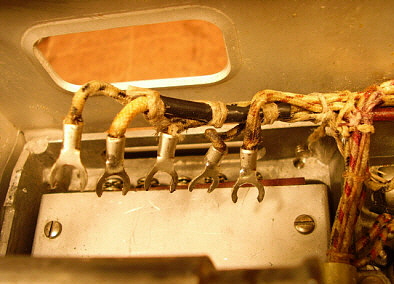
| Rebuilding the Wiring Harness Back to Original
-
Identify each of the wires from the harness that are going to have to
connect to the dynamotor terminals. There should be five wires. HV+
is the B+ line (consists of two white with red tracer wires.) HV-
is the B- and bias line.
Blank or "not ID'd" is the connection for the tube heaters
- it is internally jumped to LV+
inside the dynamotor chassis. LV+ is the switched +24vdc and dial
lamps line. LV- line is connected to chassis. Normally, modifiers
didn't change any of the wiring placement in the harness so, hopefully,
all that will be required is to install spade lugs on the wire sets. You
may have to add wire if the length of the original wire has been cut to
fit into the modified AC power supply. Every modified BC-348 is somewhat
different but try to keep to original wiring routing as much as
possible. If the either LV line needs to be lengthened be sure to use
16ga. wire on these lines. Once you have the order and length correct,
then install the spade lugs. These have to be soldered to the wire ends,
as original. Remove any plastic insulation on the spade lug ends and
then solder to the wire ends. To make the harness look original
install cable lace made of waxed string. Connect wire harness to the
dynamotor terminal board to complete the installation.
|
![]() |
| Powering the BC-348 with 24vdc to 28vdc - The original power source for the BC-348 was the aircraft battery-charger buss that provided around 24vdc when the airplane was on the ground. This was usually when all the equipment was pre-flight tested and the BC-375 transmitter set-up for the frequencies to be used by the radioman. Once the aircraft was in flight the battery-charger system provided nearly 28vdc to the radio equipment. If you are going to operate the BC-348 on batteries expect the voltage to vary from fully charged at about 27.5vdc down to 23.5vdc (when the batteries need to be charged.) If you are going to operate the receiver on a DC power supply, provide about 27vdc for good operation of the tube heaters and the dynamotor. The DC power supply will have to be capable of providing around 10A for the surge current to start the dynamotor. After the dynamotor is up to speed the current draw is usually less than 2A. | For initial testing connect +27vdc to pin 3 or 4 on SO-143 and connect the negative lead to pin 8 or 7. Be sure to use a test jump between pin 2 and 6 to take the receiver out of stand-by. With the +27vdc on, switch the AVC-OFF-MVC switch to AVC. The dynamotor will come on along with the dial lights. After about 30 or 40 seconds the receiver should come to life. Use earphones (of the proper Z for what you have T-115A/B wired for) and tune in some stations on SW BC. Check all of the controls and see that they function. Tune in stations on all bands to test. Switch to MVC and turn on the CW OSC. You can now tune in some SSB or CW stations on the ham bands. Note that in AVC, the VOLUME will be set rather low since the AVC is controlling the receiver sensitivity and VOLUME controls the audio gain. In MVC you'll have to advance the VOLUME higher since VOLUME now controls sensitivity and the audio gain is at maximum. This gives the proper ratio of RF to BFO injection for good CW or SSB demodulation. |
| IF Alignment - The BC-348 uses an Intermediate Frequency of 915kc. The passband selectivity is directly related to how the IF is aligned. There are other factors, such as the amount of coupling in the IF transformers and other factors of design, but an accurate alignment of the IF system will result in the best selectivity that the BC-348 is capable of. You will have to determine the exact crystal frequency of the Crystal Filter first. This can be determined by switching in the Crystal Filter and then sweeping an RF Signal Generator coupled to the converter grid. The crystal should be very close to 915kc. You'll hear a "peaking" of the background noise as you sweep through the crystal frequency. At the exact peak of the response is the exact crystal frequency. Whatever the crystal frequency is, that is where the RF Signal Generator should be set for the IF alignment. Next, adjust all of the IF transformers, both top and bottom adjustments, for the peak response to the RF Signal Generator input frequency. Monitor the audio output using an AC voltmeter. You'll have to use 400~ modulation on your RF Signal Generator for the meter to read and operate the receiver in MVC for the best results. | You can also use an unmodulated signal and monitor the
AVC line, with the receiver in AVC. If you have a digital frequency
counter monitoring the RF Signal Generator frequency, check it often as
you proceed with the IF adjustments. Go through all of the IF
adjustments twice to assure accurate adjustment. This method of
alignment will result in the best IF selectivity for the BC-348. Also,
the Crystal Filter will operate correctly since the IF is adjusted to
exactly the crystal frequency.
RF Alignment - The accuracy of the RF alignment affects how well the BC-348 tracks - that is, how accurate the dial readout is. Since the receiver was adjusted at the factory with more or less fixed components, there are no padder adjustments for the tracking except for the LF band. The tracking is adjusted with trimmer capacitors on each of the tuning ranges. These are adjusted at the top of each of the bands. How accurately you adjust the RF Signal Generator frequency input, the receiver's tuning dial and each of the trimmers, results in how accurate the final tracking is. Most BC-348 receivers adjust up to be very accurate - within the limits of an analog readout and a tuning range that spans several megacycles. |
|
Performance Expectations |
![]() The completed Wells-Garner & Company BC-348-Q sn: 11227 |
The BC-348 is an amazing receiver and the more you use it, the more you'll appreciate the fact that these great performing receivers do so much with so little. Being an aircraft receiver, weight had to be kept to a minimum but this little receiver has two RF stages, three IF stages, a Crystal Filter, a BFO, an accurate dial readout, on and on. I find that the BC-348-Q is fully capable of being used as the station receiver in my SCR-287 station. During most check-ins to the West Coast Military Radio Collectors Group Net, I haven't found any advantage to changing receivers. The BC-348-Q is plenty sensitive enough. I have the IF adjusted for a tight passband and haven't had adjacent frequency interference hinder copy. Now, can I hear the adjacent frequency activity? Of course, but it doesn't prevent solid copy of the station tuned in. I've sometimes thought that maybe I'd have better reception using the AN/GRR-2 (military SX-28A) but after switching receivers I found no definite advantage other than the adjustable selectivity of the AN/GRR-2. The only real advantage was in going to an R-390 receiver but a comparison to the selectivity capabilities of that receiver would be ludicrous. Deliberate, on frequency QRM is another matter and no receiver, no matter how sophisticated, can cope with that kind of interference. I've used the BC-348-Q on CW also. It's a very good CW receiver with very little drift. Of course, the lack of a lot of CW activity these days doesn't offer up much of a challenge to the BC-348-Q's selectivity. I haven't ever had to use the Crystal Filter on CW. Don't be afraid to use the Crystal Filter, it works great when it's aligned correctly and working right. The Crystal Filter will help on adjacent frequency interference on AM - just be sure to tune the incoming signal "on the nose." I always find the performance of the BC-348-Q to be a pleasant surprise. Probably because, over the years, I have always heard so many negative comments about the receiver's lack of selectivity and limited features - but this just isn't the case. The BC-348-Q is a great performer that always delivers solid copy even in tough conditions. |
|
The SCR-287 Station - The SCR-287 comprised a complete liaison radio station installed onboard various bombers and transports during WWII. The transmitter used was the BC-375 along with the BC-348 as a receiver. Though the BC-375 was designed in the early thirties and built from the mid-thirties on up to mid-WWII, it found a long-term usage with the Signal Corps due to its ease of operation and reliability. The BC-375 uses four VT-4-C triode tubes (type 211) and a single VT-25 (10Y) triode with one VT-4 used as the Master Oscillator, another VT-4 as the Power Amplifier and two VT-4 tubes for the P/P Modulator. The VT-25 serves as the speech amplifier in the Voice mode (AM,) as a 1000hz oscillator in the Tone mode (MCW) and as a sidetone oscillator in the CW mode. Power is provided by the aircraft battery/charger system (24 to 28vdc) and by a high voltage (+1000vdc) dynamotor (PE-73.) The transmitter frequency range is determined by which of the seven Tuning Units is installed in the transmitter. The coils and condensers and connections for the MO and PA are contained in each TU. The range of frequencies is from 200kc to 500kc and from 1500kc up to 12500kc using the various TUs. The controls aligned vertically on the right side of the transmitter make up the wide range antenna coupler for the transmitter. The BC-306-A located to the right of the BC-375 is the LF Antenna Tuner allowing further extension of antenna matching ability below 800kc using the typical trailing wire antenna. Power output is between 80 and 90 watts. The BC-375 provides full break-in keying by allowing the elaborate internal antenna relay to control the receiver antenna and the receiver standby circuit. Additionally, external inputs via the PL-64 cable allow remote microphone and key operation along with remote power control. The aircraft was usually set-up to allow the pilot to also access the transmitter/receiver for various reasons. The BC-348-Q receiver is installed into a homemade wooden console that features a fold-down desk for easy CW sending and copy along with taking notes for AM QSOs. The outputs taken from the PL-103 plug on the back of the FT-154 shock mount for the BC-348 and are routed to the panel to the left of the receiver. Audio outputs can be taken from the phone jacks and routed up to the LS-3 speaker or used to drive a set of 'phones. The Standby function is controlled by the Send-Receive relay in the BC-375 and automatically puts the BC-348 into standby when the transmitter is keyed. The Antenna and Ground connections also run up to the BC-375 antenna relay and automatic switching of the antenna occurs with transmitter keying. The power cables for the battery voltage are routed from the battery pack up to the SO-143 plug on the rear of the BC-348 and directly to the PE-73 dynamotor for the BC-375. The other components shown are the Lionel J-47 telegraph key and the Shure Bros. T-17 microphone. The T-17 is modified to use a crystal element and runs through an in-line amplifier. This set-up allows the BC-375 to remain totally stock and to benefit from the use of a crystal mike rather than the original carbon T-17. The speaker is an LS-3 (modified for 600 ohms Z input,) although these were never used in the SCR-287 or onboard the aircraft. Four BC-375 Tuning Units are mounted in their CS-48 containers on the wall. The homemade console features a fold-down desk, a sound-proof (almost) compartment for the PE-73 dynamotor and a bottom shelf for the four storage batteries (four 12v batteries in series-parallel = 24vdc, 27.6vdc when fully charged) that power the entire station. I use the SCR-287 when conditions allow for decent copy considering its rather modest power output. I use the 135' center-fed doublet as an antenna which, through a coupler, provides a perfect 50 ohm unbalanced match for the BC-375. |
![]() SCR-287 Station |
Henry Rogers WA7YBS/WHRM © JAN 2010
____________________________________________________________________
Donations to the Western Historic Radio Museum and the Museum's Website
If you enjoy using the Western Historic Radio Museum's website as an information resource and have found our photos and hard to find information helpful, please consider a donation to the WHRM. A small donation, such as our normal Museum admission fee of $5.00, will help with the expenses of website operation and also help keep the Western Historic Radio Museum open to the public. The WHRM has been an "Open-to-the-Public" museum since 1994 and has provided an on-line information source in its website operation since 1997.
You can use PayPal for sending a donation by clicking on the "Donate" Button below
If you prefer sending a check, MO or cash donation, please make the check or MO payable to "Henry Rogers" and mail to:
Western Historic Radio Museum
P.O. Box 73
Virginia City, NV 89440 USA
Website Navigation Index
|
- Museum Information - Nevada Radio History - Parish House - (Full Length Articles with Photos) - Items For Sale - |
|
History of the Parish House (1876) |
Nevada Radio History - 1906 to 1930 |
|
- Wireless Apparatus & 1920s Communications Equipment ~ Full Length Articles with Photos - |
|
M.H. Dodd's 1912 Wireless Station 10th Anniversary Edition with New Photos |
SE-1420, IP-501 & IP-501A "The Classic Shipboard Wireless Receivers" |
|
- Vintage Communications & Amateur Radio Equipment ~ Full Length Articles with Photos - |
|
Hallicrafters SX-28 |
Hallicrafters DD-1 "Skyrider Diversity" |
Comprehensive History, Restoration, Sweep Alignments & More NEW! |
Hammarlund Mfg.Co.,Inc |
|
BC-348 Receiver - How to Return to Original Dynamotor Operation |
Rebuilding the Hammarlund SP-600 |
Vintage
Long Wave Receivers |
|
|
- Radio Photo Galleries ~ with Text - |
|
Entertainment Radios |
|
Communications, Amateur & Broadcast Equipment |
|
Other Radio Related Articles |
|
Telegraph Keys - "From Straight Keys to Bugs" - 1900 to 1955 |
Western Historic Radio Museum
Vintage Radio Equipment and Memorabilia
from 1910 through the 1950s
P.O. Box 73
- Virginia City, Nevada 89440 USAOwners/Operators:
Henry Rogers - WA7YBS
Sharon Rogers - KK7EI
This website created by: Henry Rogers-Western Historic Radio Museum © 2000/2010